
“Fjord” is Staggering and Cold
Winning the Cannes Palme d’Or is usually a sign of a successful awards season to come. In 2024, Sean Baker’s Anora took home the grand prize and went on to win five of the six Academy Awards it was nominated for. This year, the highest honor of the Cannes Film Festival went to Cristian Mungiu’s Fjord. Not only did it win the Palme d’Or, but Fjord also picked up the François Chalais Prize, the FIPRESCI Prize, the Prize of the Ecumenical Jury, and the Prix de la Citoyenneté. Fjord’s inclusion in the 2026 Toronto International Film Festival marks the film’s Canadian premiere. Needless to say, its arrival was highly anticipated.
A family moves to a small town in Norway. The father, Mihai (Sebastian Stan), is Hungarian, and the wife, Lisbet (Backrooms’ Renate Reinsve), is Norwegian. Their five children range in age from baby to teenager and, by all accounts, are happy. It’s an adjustment for the family, but Mihai finds a good job in town through a church connection and Lisbet works as a nurse at an elder home. All is well until a teacher notices bruises on the body of their eldest daughter, Elia (Vanessa Ceban). This launches a massive investigation that removes all five children from the home and puts the family on trial, both legally and socially.
Mungiu’s script was inspired by a true story. The Bodnariu case occurred in 2015, and much of the story of Fjord mirrors that of the real family. The number of children and their ages slightly differ, but the key facts remain the same. The family members at the center of the child abuse allegations are devout, conservative Christians, and immigrants. They claim that the actions taken by the government placed them on the receiving end of religious persecution and infringed on their right to raise their kids as they see fit. Fjord doesn’t claim to be an adaptation of what happened to the Bodnariu family, nor does it even mention the real case, which is what gives it a little more flexibility in terms of what people expect when a film is “inspired by a true story.”
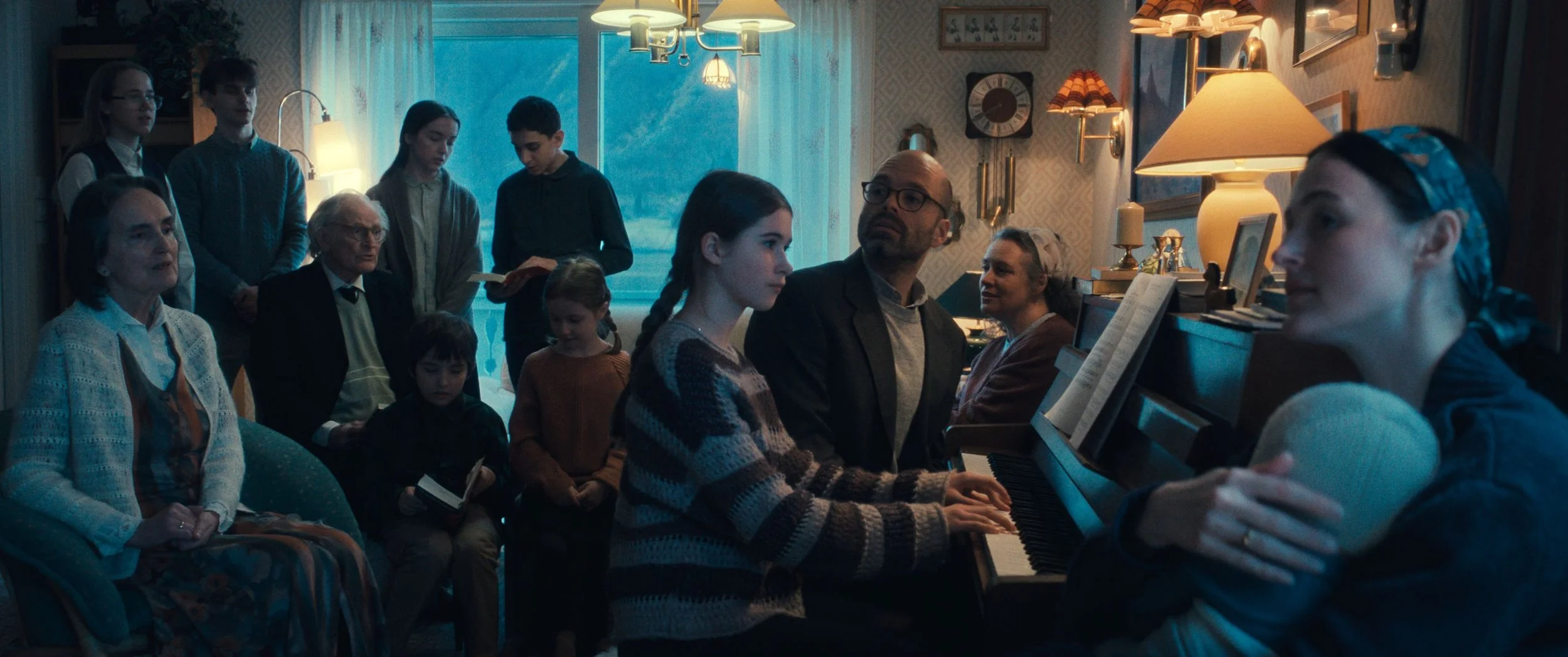
Courtesy of NEON
The core themes of the Bodnariu family’s experience remain unchanged. At the post-screening Q&A, Mungiu explained that he wanted the point of view of the film to be neutral. Fjord sets conservative religious beliefs against open tolerance. Mungiu explained that should he have come down hard on one side, the other side would have tuned out everything the movie had to say. He’s right in the sense that level-headed conversations are certainly hard to come by in this day and age. Fjord offers that opportunity by slowly parsing out information, forcing the audience to reconsider their snap judgments. As the Q&A progressed, Mungiu mentioned that he was interested in the way some countries are very open to immigrants but don’t help them understand the societal norms of the place they’ve moved to.
Fjord is anchored by the impeccable performances of Reinsve and Stan. They’re restrained, yet the audience can feel the fury bubbling beneath their skin. Their children have been taken away, of course they want to scream about it, but doing so would only bolster the case of the government. The kids, though, don’t have any opportunity to speak. Throughout the film, adults are telling each other what the kids have experienced. The eldest children do speak with a counselor, but the audience doesn’t hear exactly what the kids tell the adults at school. For a film that’s about the safety of young people, Fjord misses that perspective.
In a time when the world is splintered, Fjord doesn’t fully bridge the gap between these two sides of the argument. Because of Mungiu’s more reserved, exterior approach to this debate, Fjord feels a little hollow after it sits with the viewer for a few days. In the immediate aftermath, Fjord is staggering. It’s a daunting, intense circumstance that is impossible to fathom until one lives it. As that overwhelming sensation subsides, it becomes apparent that Fjord could stand to have a little more pushback, a little more friction in this conversation of societal expectations. It’s not about which viewpoint the audience agrees with, but Fjord doesn’t dig into the problem in the way a film with a direct point of view would have. Fjord is a mirror held up to current society, and one that could stand to be less subdued.

Follow me on BlueSky, Instagram, Letterboxd, TikTok, YouTube, & Facebook. Check out Movies with My Dad, a podcast recorded on the car ride home from the movies.
support your local film critic!
~
support your local film critic! ~
Beyond the Cinerama Dome is run by one perpetually tired film critic
and her anxious emotional support chihuahua named Frankie.
Your kind donation means Frankie doesn’t need to get a job…yet.