
“Leviticus” is Too Much Queer Pain (Copy)
One of the most common religious refrains against homosexuality comes from the Bible’s Book of Leviticus. Leviticus 18:22 says, “you shall not lie with a male as with a woman; it is an abomination.” There’s great debate, however, about the intention behind that line, and a 2022 documentary, 1946: The Mistranslation That Shifted Culture, discusses how an erroneous translation fundamentally altered the way Christianity views queerness. Adrian Chiarella’s Leviticus is not about that error, but about the world it created for two teenage boys in rural, conservative Australia.
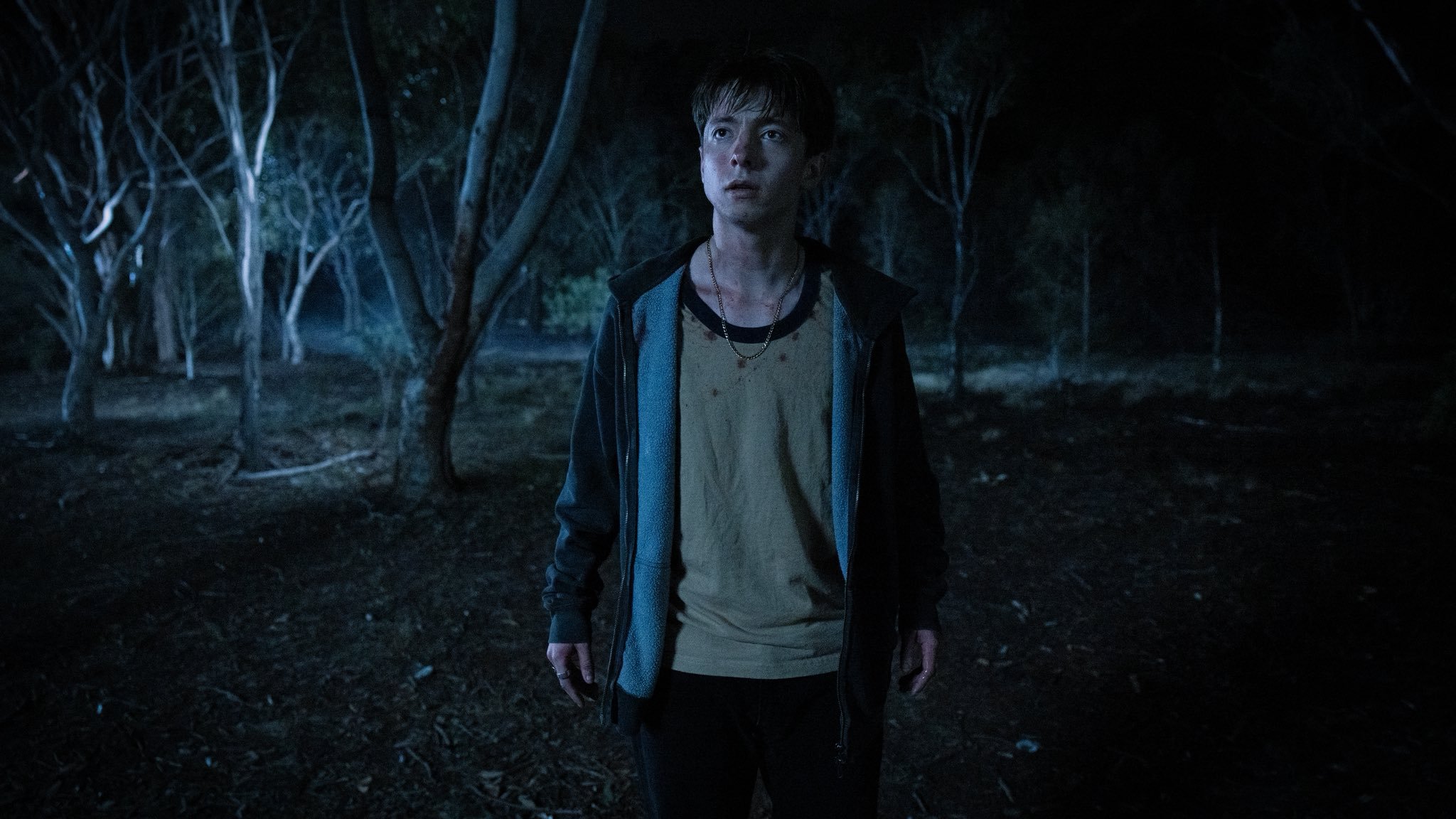
Naim (Joe Bird) and his mother (Mia Wasikowska) have recently moved into an isolated community in Victoria, Australia. He’s a bit of a loner, but the film begins with Ryan (Stacy Clausen) asking him to hang out. They wander through fields and abandoned factories, saying very little to one another but communicating physically. They push, they shove, they tumble to the ground, but they linger a little too long for this to feel platonic. The two eventually kiss and a romance begins to play out, hidden in the shadows because of their families and the town’s deep-rooted religious beliefs. They’re eventually caught, and the pastor brings in a Deliverance Preacher (Nicholas Hope) who subjects the boys to a conversion ritual to “cure” them. Instead of removing their desire, this ritual binds an entity to them that takes the form of the object of their affection, stalking them violently and relentlessly.
If you’re a horror fan, the description of the entity will likely bring It Follows to mind. The comparisons are fair. Both films feature a spirit that can only be seen by the one(s) who have been affected, and the looming threat is connected to sex or sexuality in some way. In It Follows, the entity is treated like an STD, where the only option to get rid of it is to sleep with someone else. In Leviticus, the entity has essentially been formed through the sexual attraction that society has deemed immoral. In this sense, the entity in Leviticus perfectly captures the inescapable feelings of desire that occur when someone is figuring out their sexuality. This person brings so much joy, but their existence can also create anxiety, violence, and isolation, especially in religious communities like the one in Leviticus.
Courtesy of NEON
The entity that has attached itself to Naim and Ryan takes the form of these boys because Naim is the person Ryan most desires and vice versa. Despite being some of the only people who are aware of this reality, they struggle to confide in each other because they can’t tell if they’re speaking to the real person or the violent supernatural force. This adds to the isolation these boys already feel. The problem with this scenario is that so much of Leviticus devolves into violence. It’s unfortunately common for young queer people to experience brutality at the hands of their friends, family, and peers, who they thought were also exploring their sexuality. In Leviticus, Naim and Ryan are the ones who are beating each other to a bloody pulp. It’s a weighty statement, and one that does have real roots in the queer experience, but one it isn’t supported by a fleshed-out dynamic between these two characters.
It’s not just the relationship that’s missing something. The larger exploration of Christianity’s impact on young people feels a little underdeveloped. There are plenty of examples of religious horror, queer or otherwise, and Leviticus has borrowed bits and pieces of what came before to construct its narrative. The film is gorgeously shot, the tone and suspense are well-developed, and Clausen and Bird are capable of handling themselves with the few weighty scenes, but Leviticus leaves a lot to be desired. It’s not enough to create a tense tone with a topical, social throughline. The film needed to do something with those ingredients to elevate them. As it stands, the amount of violence inflicted on these boys is uncomfortable without a strong narrative purpose other than the vague idea that Christianity breeds these brutal exercises to change an aspect of someone that cannot be changed. There are plenty of things to be wary about and afraid of in the world, but Leviticus isn’t one of them.

Follow me on BlueSky, Instagram, Letterboxd, TikTok, YouTube, & Facebook. Check out Movies with My Dad, a podcast recorded on the car ride home from the movies and I Think You’ll Hate This, a podcast hosted by two friends who rarely agree.
support your local film critic!
~
support your local film critic! ~
Beyond the Cinerama Dome is run by one perpetually tired film critic
and her anxious emotional support chihuahua named Frankie.
Your kind donation means Frankie doesn’t need to get a job…yet.