
“Mustache” is a Delight
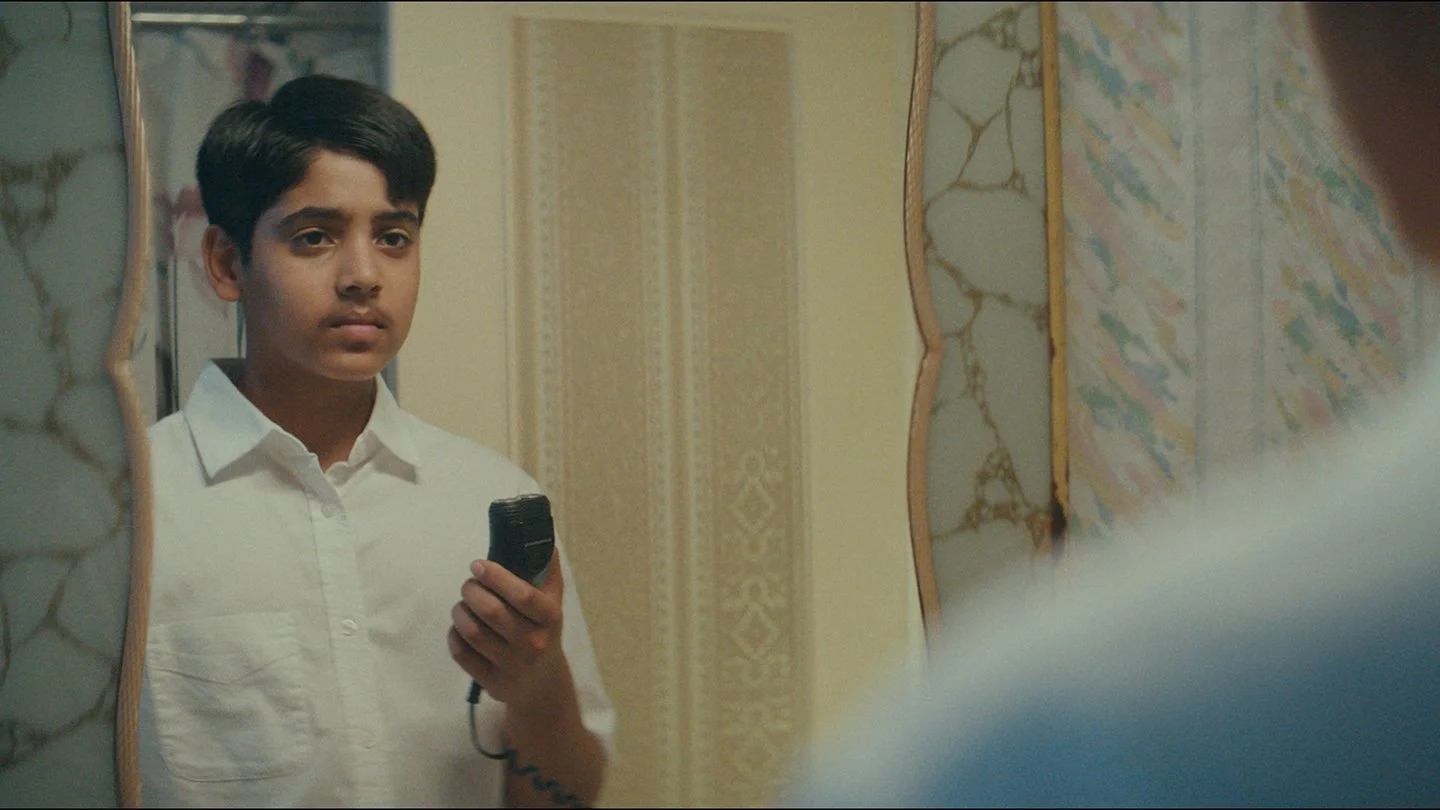
Regardless of gender, nationality, or any other defining characteristic, all teenagers have heard the myth that once you start shaving, your hair will grow back thicker than before. For whatever reason, that tends to strike fear in the hearts of many a tween as puberty knocks on their door. In Imran J. Khan’s Mustache, this fear looms over the lip of Ilyas (Atharv Verma) in the form of a prepubescent mustache. As much as the title implies that this is a movie about facial hair, and it certainly does play a major role, Mustache is about growing up in an immigrant family. It addresses the push and pull that comes from wanting to honor your family and beliefs while also beginning to understand your own sense of personhood.
In order to make sense of his existence, Ilyas has created a detailed flowchart that helps him determine the decisions he should make. He’s guided by Islam, his parents (Rizwan Manji & Meesha Shafi), and the expectations of his community. When he’s attending his Islamic private school, these rules are easy to follow, but when his parents send him to public school, everything he knows is upended. Desperate to get back to a sense of order, Ilyas hatches a plan to make his parents think he’s a “bad kid” who needs the Islamic private school to sort him out again. In pretending to rebel, Ilyas discovers how to accept himself as he is.
Courtesy of Mustache
Throughout Mustache, Ilyas offers voiceovers about his mental state and decision-making process. This is more frequent in the beginning of the movie, when he’s making excuses for the ways he shrinks himself to fit into what his parents expect of him. He explains, “I’ve chosen obedience over my self-interest.” Ilyas says it without an ounce of introspection about what this decision means for his own emotional growth. How shrinking himself doesn’t benefit anyone, least of all Ilyas. At first, public school is a nightmare, a minefield of mistakes he could make and societal expectations he doesn’t understand. The longer he stays, the more he learns about his own wants, dreams, and desires. He finds himself in an acting class because he followed a girl (Melody Cao) he has a crush on. Ilyas is able to flex his creative muscles in a way he never has before, a gift all of us should be so lucky to experience.
Even though much of the tension in the film comes from Ilyas and his struggles to fit in, Mustache isn’t pitting rigid traditionalism against the freedom that modernity brings. Not entirely, at least. Many films that depict this parental/child relationship dynamic reduce the tension to that of the old ways versus the new. Mustache shows that Ilyas can find a balance between honoring his beliefs and adapting them to match the new world the ’90s have ushered in. This is the friction of immigrant kids who don’t see themselves as one identity, but a combination, and how identifying in that manner can create distance between themselves and their parents.
Even as an outsider, it’s clear there are moments in Mustache that will feel acutely in tune with the Pakistani-American experience. It mirrors my own reaction to seeing My Big Fat Greek Wedding for the first time as a Greek-American. In that same breath, Mustache speaks to the universality of being a high school freshman and having no idea where you fit in the world. There are glimmers of Lady Bird and Rocket Science here in their shared celebration of the weird kid who rarely sees themselves in the spotlight. It’s cliche at this point, but in specificity lies universality. The viewer doesn’t have to be a Pakistani-American kid in the ’90s to get Mustache, but that probably elevates it to another level. In order to enjoy Mustache, you just have to be willing to go back to the awkward teenage years of finding yourself — the often uncomfortable, sometimes profound, and always shifting time when the tickle of a prepubescent mustache can change the world.

Follow me on BlueSky, Instagram, Letterboxd, TikTok, YouTube, & Facebook. Check out Movies with My Dad, a podcast recorded on the car ride home from the movies and I Think You’ll Hate This, a podcast hosted by two friends who rarely agree.
support your local film critic!
~
support your local film critic! ~
Beyond the Cinerama Dome is run by one perpetually tired film critic
and her anxious emotional support chihuahua named Frankie.
Your kind donation means Frankie doesn’t need to get a job…yet.