
“Primetime” Sees How this Looks and Hates it
“Why don’t you have a seat?” For twenty episodes, that question would send shivers down the spine of adult men who thought they’d just arrived at the home of a minor. It’s the catchphrase of sorts for Chris Hansen, the host of To Catch a Predator. Thousands of people around the world this weekend will do as Hansen famously asked and take a seat in a theater to watch Lance Oppenheim’s Primetime. Primarily a documentarian, Oppenheim makes his first foray into narrative feature filmmaking with Primetime, a movie that it seems Hansen himself wishes didn’t exist.
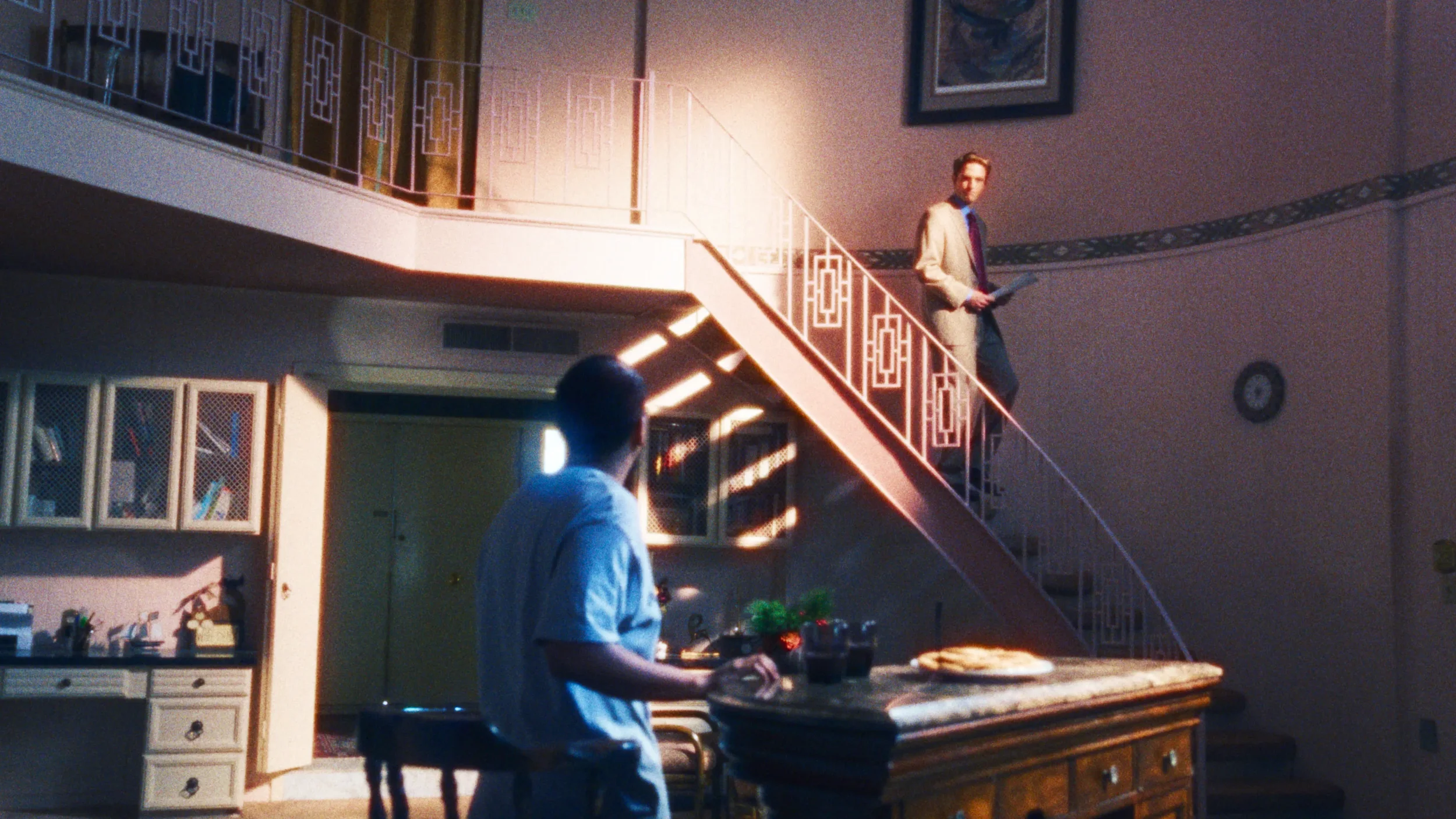
The film opens with hazy, soft colors. A man’s voice is repeating a phrase over and over again. This is Chris Hansen (Robert Pattinson). He’s in the bathroom of a house that’s covered in cameras. Any minute now, a man will come to the door to see the minor child he thinks he’s been chatting with. In actuality, it’s a young woman (Phoebe Bridgers), a decoy, who can pass for a tween. When he gets the signal, Hansen enters the room and utters the famous phrase, “why don’t you have a seat?” Primetime follows Hansen as he gets the news that his show, To Catch a Predator, will be moving to the big leagues to play ball against Lost in the primetime slot. Armed with his right-hand producer (Merritt Wever), a new decoy (Skyler Gisondo), and an online vigilante (Matthew Maher), Chris Hansen believes he has what it takes to gain infamy.
Courtesy of A24
The look of Primetime is a magic, time-travel trick in its own right. Cinematographer David Bolen told IndieWire that he shot the movie on “more than a dozen camera bodies and at least 10 different formats.” The ALEXA 35 was the main staple, but they also used an Endoscope Colonoscopy camera for a scene dealing with a computer screen. There’s enough softness, haze, grain, and slightly blown-out color for Primetime to feel mythological and larger-than-life, yet also vintage. So many people remember To Catch a Predator from its slightly muddled reruns, a reminder of a simpler time of filmmaking. The low-fi nature of Primetime creates unease when coupled with Oppenheim and Bolen’s up-close framing of the characters’ faces. The duo has worked on five projects together, and the synergy is firing on all cylinders in this film. Primetime is in-your-face, relentless, an unnerving thrill ride.
As a documentarian, Oppenheim lingers in rooms and on people. In his docuseries Ren Faire or his first feature, Some Kind of Heaven, there are plenty of eccentric characters to follow. Like his upcoming collaborator Nathan Fielder, Oppenheim lets the viewer sit with the scene before them. In Some Kind of Heaven, that could be the discomfort of seeing funeral planning unfold in a Ruby Tuesday’s. In Primetime, it means watching the obsessive way Chris Hansen attempts to manufacture perfection. The way he repeats the horrifying chat messages from the pedophiles so he can dole out the most damning when the time comes. Oppenheim doesn’t cut or reframe, but plants the camera to force the viewer to let the moment wash over them. There’s no relief in Primetime, nor should there be. With Primetime, Pattinson feels firmly in the lead for the Best Actor awards season. His imitation of Hansen’s voice will make your skin crawl. It’s Gisondo, too, who is an utter force in the film. The aftermath of his character’s first time as a decoy solidifies how deep Gisondo can go as a performer.

Courtesy of A24
One could point to To Catch a Predator as a turning point for the way that crime can be turned into content. How exploitation is the lowest form of entertainment, yet it sells. Call it morbid curiosity, but humans cannot look away from a trainwreck. The problem is not that they notice the trainwreck, but what they do about it once they see it. To Catch a Predator, in its heyday, received criticism for the legality of its “sting” operations and tawdry approach to a very real issue. Two things can be true. One, pedophiles should be brought to justice. Two, that justice shouldn’t unfold on television in this manner. In 2025, the series was the subject of David Osit’s documentary. Predators. It chronicled the rise and fall of the series, Osit’s own relationship to the show, and includes an interview with Chris Hansen himself. The documentary works as a compelling double feature with Primetime as an exploration about the ramifications of intertwining trauma and spectacle. Primetime mythologizes the man behind To Catch a Predator and the country who watched him.

Follow me on BlueSky, Instagram, Letterboxd, TikTok, YouTube, & Facebook. Check out Movies with My Dad, a podcast recorded on the car ride home from the movies.
support your local film critic!
~
support your local film critic! ~
Beyond the Cinerama Dome is run by one perpetually tired film critic
and her anxious emotional support chihuahua named Frankie.
Your kind donation means Frankie doesn’t need to get a job…yet.