
“The Big Combo” Comes Home Newly Restored
The genre of film noir rose to prominence in the 1940s and 1950s as a reaction to the loss of innocence that came from World War II. These films, as compared to earlier works, capture a sense of cynicism that permeated the culture during and after the war. Given the state of politics in 2026, it’s no surprise that a renewed focus is falling on film noir.

Courtesy of Ignite
The Big Combo is one example of a gem of the genre getting the 21st-century overhaul treatment. Originally released in 1955, Ignite Films has put together a stellar, comprehensive rerelease in time for the 70th anniversary of the film.
The Movie
The Big Combo, like many of the noir films of the era, is a gangster and detective saga. The good and the bad are duking it out, but the line between the two is never as clear as it seems. In The Big Combo, Leonard Diamond (Cornel Wilde) is a police lieutenant who’s obsessed with taking down Mr. Brown (Richard Conte), a gangster. There’s a wrinkle in Leonard’s fascination with Mr. Brown, and that comes in the form of Mr. Brown’s girlfriend, Susan Lowell (Jean Wallace). Leonard is in love with Susan and believes that if he can mount a solid enough case against Mr. Brown, Susan will love him.
In the seventy years since its release, The Big Combo has gone through a series of reassessments by contemporary film critics. Quentin Tarantino cites it as the inspiration for a torture scene in his 1992 film, Reservoir Dogs. It’s not often that a film noir, an era somewhat famously known for its restraint, serves as inspiration to a director known for his violence. It’s proof that audiences didn’t entirely know what to make of The Big Combo upon its initial release.
Even then, though, critics and audiences, new and old, recognize that the film has shortcomings. The plot is more than a little bit of a mess, barely held together by the loose threads of the genre. What makes The Big Combo stand tall in retrospect are the artistry of the lavish set pieces, the famed stars of yesteryear’s Hollywood, and an end to an era.
It’s impossible to talk about The Big Combo without mentioning cinematographer John Alton. To peruse Alton’s filmography is to see Hollywood growing and adapting through the years. Alton’s camera work defined much of the film noir genre in the ’40s, and he won an Academy Award for An American in Paris in 1951. Few can say they’ve had such a varied career, and Alton’s work on The Big Combo, in all its restored glory, should not be missed.
Look & Sound
Ignite Films’ restoration was made from a 35mm Fine Grain Answer Print and a 35mm Optical Sound Negative. The Grainery was responsible for the 4K visual restoration and the audio was worked on through UCLA, funded by The Film Foundation. A color grade was added to the final product by Gosia Grzyb, whose work was overseen and approved by Scott MacQueen.
Courtesy of Ignite
The efforts of all these preservationists are clear when watching The Big Combo. Alton’s cinematography is the stuff of legend for film noir enthusiasts, and the restoration allows the modern viewer to get a taste of his work looking as close to its original glory as possible. The final shot is one that lingers, a quintessential reflection of Alton’s work and the era as a whole.
Extras
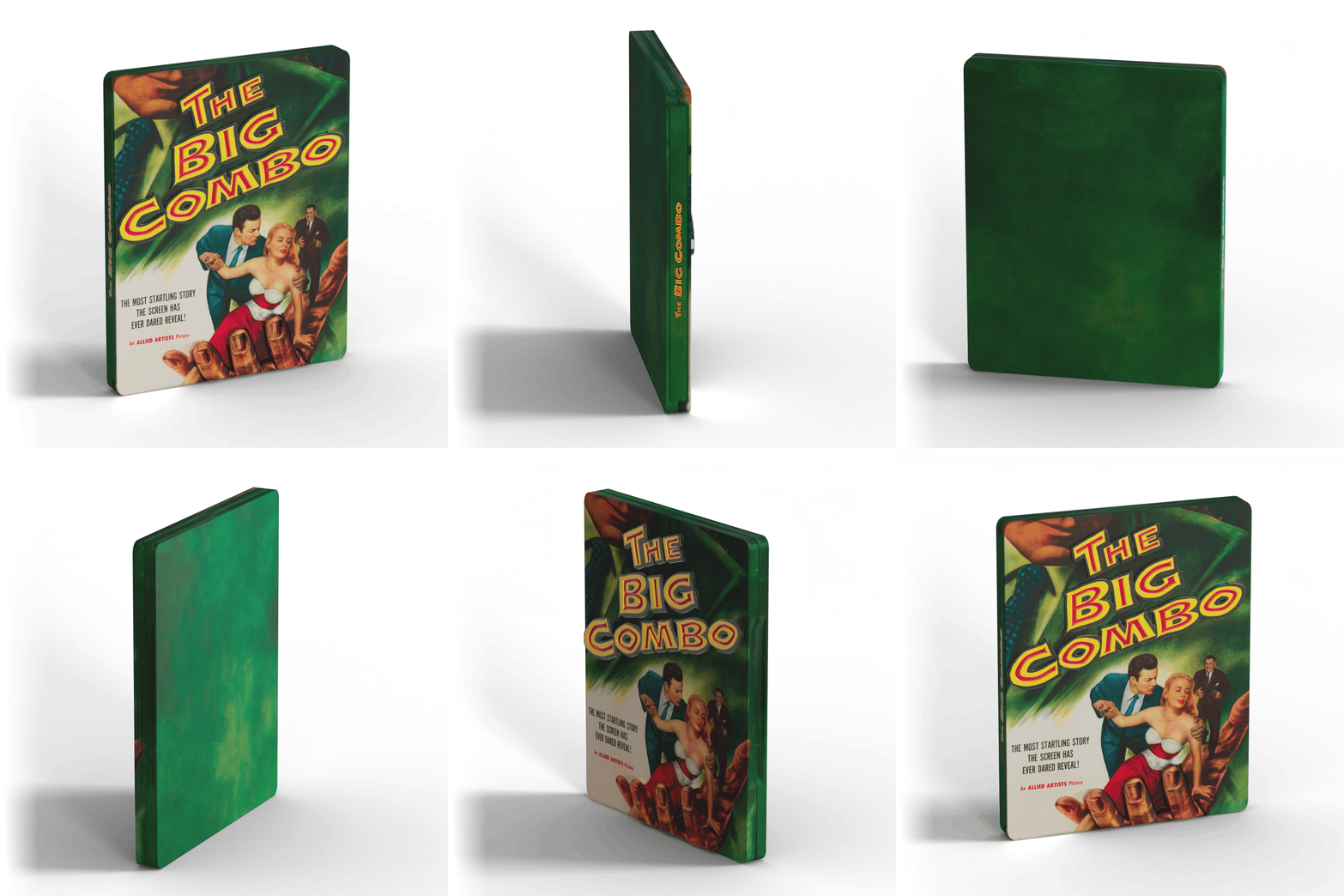
Ignite Film’s release of The Big Combo has four editions. Its most basic, a standard Blu-ray, features reversible cover art, a curated booklet, and five lobby cards. The 4K UHD Standard Edition also features reversible artwork. There are also two steel book editions. One features the original movie poster artwork and the other has a newly commissioned cover. Each steel book edition is a three-disc set with a curated booklet and five lobby cards.
Only the steel books feature all of the bonus features, including Legacy and Newly Produced features that contextualize The Big Combo’s place in film noir history. Perhaps the most exciting addition to the release is the inclusion of the 1949 film The Crooked Way. Directed by Robert Florey, The Crooked Way was also shot by Alton.
Legacy Bonus Features:
Audio Commentary with Eddie Muller, the “Czar of Noir” and founder of the Film Noir Foundation
Geoff Andrew, respected critic and curator, on The Big Combo
Wagon Wheel Joe: A fascinating video appreciation of Lewis’s dynamic camerawork and recurring motifs, tracing his evolution from B-movie craftsman to master stylist
Newly Produced Bonus Features:
New Audio Commentary with acclaimed film historian and noir expert Imogen Sara Smith
New Interview with celebrated author and critic Philippe Garnier
How a Guy Makes a Living — How a Little Combo Made The Big Combo: New video essay by Scout Tafoya
The Crooked Way (1949) — Another brutal noir with spectacular expressionistic cinematography by John Alton, including unfiltered filming on 1940s post-war streets of Los Angeles
Verdict
The Big Combo, for all its clunky narrative arcs, is an important piece of filmmaking that puts the film noir genre in a new light. This film is often regarded as ahead of its time and, on a second viewing when the audience is less considered with making complete sense of the narrative, that modernity is obvious. The sensuality, violence, and cruelty were shocking for the era, but they set Hollywood on the path we’re all now very familiar with.

Follow me on BlueSky, Instagram, Letterboxd, TikTok, YouTube, & Facebook. Check out Movies with My Dad, a podcast recorded on the car ride home from the movies and I Think You’ll Hate This, a podcast hosted by two friends who rarely agree.
support your local film critic!
〰️
support your local film critic! 〰️
Beyond the Cinerama Dome is run by one perpetually tired film critic
and her anxious emotional support chihuahua named Frankie.
Your kind donation means Frankie doesn’t need to get a job…yet.