
“The Boy with the Light-Blue Eyes” is a Isolationist Fairytale Warning
1973’s Wicker Man is the holy grail for folk horror. It’s the story of an outsider who finds himself on a secluded Scottish island in pursuit of a missing girl. Over the course of five decades, plenty of other filmmakers have put their own spin on the isolationist fear that Wicker Man so masterfully captured. One such recent filmmaker hails from Greece. Thanasis Neofotistos directed and co-wrote The Boy with the Light-Blue Eyes with Grigoris Skarakis. It’s a film that matches Wicker Man’s unnatural, out-of-time feeling to this dark fairytale of self-acceptance.
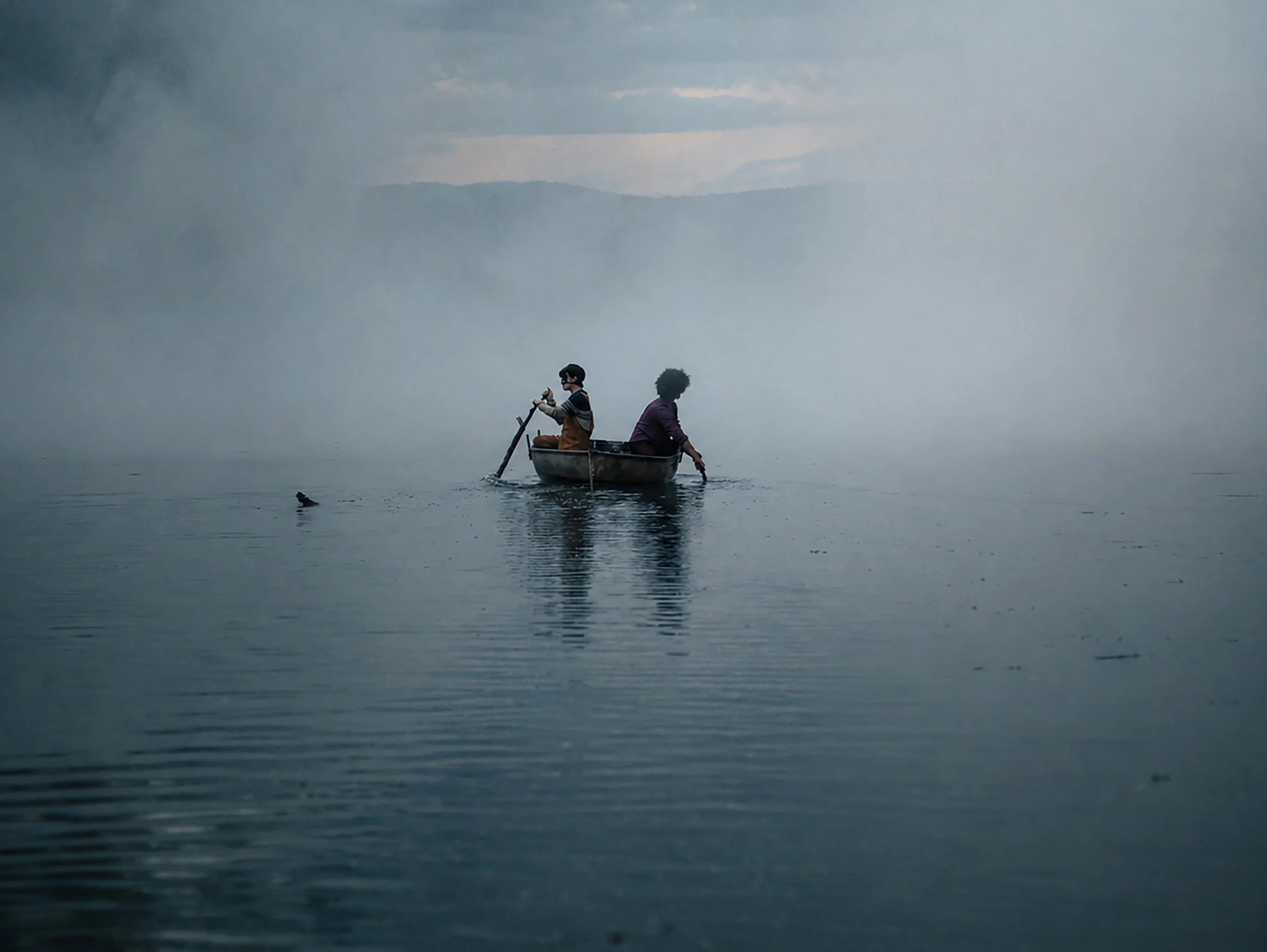
The Boy with the Light-Blue Eyes opens with a mob of angry villagers chanting about good and evil, a firm division between them. Things are hectic and violent. At the center is a young boy, Petros (Giorgos Karydis), who the horde wants to throw over a cliff. Before the viewer can get a solid understanding of what exactly is going on, the film flashes back to a few days prior. Petros and his friend Aemon (Pablo Soto) are hanging out, a moment of peace and reprieve from their stifling town. Petros has been told that he’s cursed because of the color of his eyes and is forced to wear a covering by his controlling grandmother (Sofia Filippidou) and mother (Syrmo Keke). Sick of this town and its strange beliefs, Petros and Aemon make plans to leave forever.
In Greek culture, there is a belief around the evil eye. A person may be cursed by a malicious glare and the nazar amulet is used to ward off this stare. The Greek version of the amulet is an eye that is largely blue, with a smaller white circle in the middle, then a light blue iris with a small black pupil in the middle. Petros wears a small chain with an amulet, but it’s his own light blue eyes that the rest of the town fears. While The Boy with the Light-Blue Eyes doesn’t linger on making the connection between the imagery, it’s clear that Neofotistos and Skarakis were inspired by this aspect of Greek culture.
Courtesy of Willa
For many, Yorgos Lanthimos will be what they think of when imagining the current state of Greek cinema. He’s the face of the Greek Weird Wave, and there are traces of that DNA in The Boy with the Light-Blue Eyes. The film feels modern, yet ancient. The eye covering Petros wears looks like a mix of Steampunk and futuristic dystopia, while the look of the village is from a bygone era. It’s a striking duality, as is the belief system at the core of the townspeople. In their script, Neofotistos and Skarakis have crafted a stifling environment that weighs heavily on these two boys. To add a further element of unease, the sound design is constructed to worm its way under the viewer’s skin. Certain sounds are amplified, others a constant, low hum. With one of Petros’ senses dulled, it makes sense that the film would amplify another to an unsettling degree.
Much like Wicker Man, The Boy with the Light-Blue Eyes shows the convergence of tradition, isolation, and violence. Petros’ eyes could be a metaphor for anything, but the film heavily implies a queerness at the heart of the boy’s strife. It’s a slow burn of a movie, one that is heavy under the oppression of the village it takes place in. Neofotistos’ directorial debut is confidently helmed. He’s not worried about hand-holding his audience to the thematic conclusion, trusting instead that they’re along for the ride.

Follow me on BlueSky, Instagram, Letterboxd, TikTok, YouTube, & Facebook. Check out Movies with My Dad, a podcast recorded on the car ride home from the movies and I Think You’ll Hate This, a podcast hosted by two friends who rarely agree.
support your local film critic!
~
support your local film critic! ~
Beyond the Cinerama Dome is run by one perpetually tired film critic
and her anxious emotional support chihuahua named Frankie.
Your kind donation means Frankie doesn’t need to get a job…yet.