
Tribeca: “Odessa” Dwells on the Banality of Evil
When humans are young, they’re taught that not everyone in the world is good. That there are some people who do not have the best of intentions. At that age, good and evil look very different. One is cloaked in light, the other shadows. As we age, we learn that the space between the two is far closer than we were initially taught. And that, at times, good can appear to be evil and evil can appear to be good. Writer/director Harald Swinkels’ short film, Odessa, exists in the murky in-between of our assumptions of who is good and who is sinister.
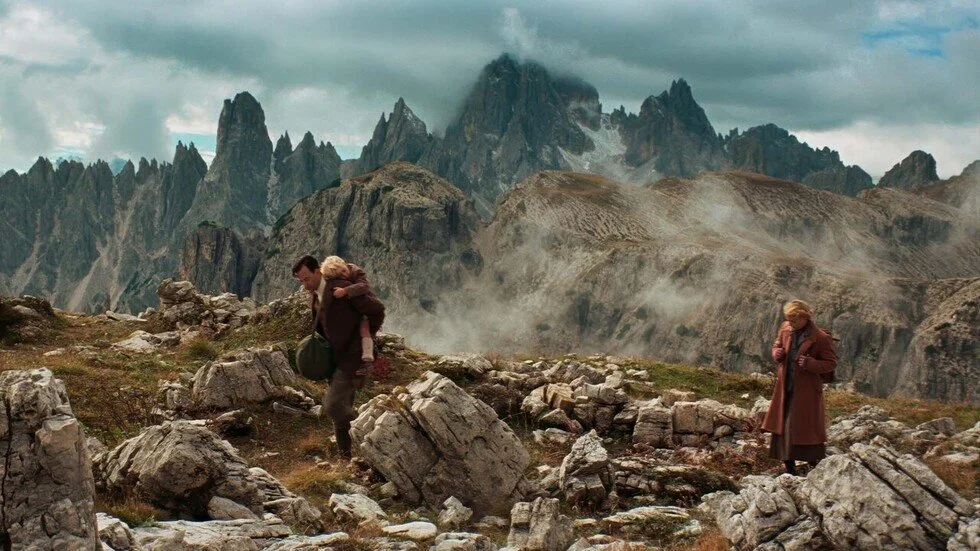
Odessa opens with a quote. “He was capable of being so kind to the children…” It describes a man who was attentive to details large and small, and whose actions were well-regarded by those who knew him. The quote trails off as the short film begins, and we don’t get an attribution as to who spoke those words. Instead, we’re introduced to a family on the run. A husband (Bastian Beyer), wife (Magdalena Müller), and their son (Tom Peper). It’s the aftermath of World War II and the family is hiking through the Dolomites, relying on the kindness of strangers to feed them. Not all in this picturesque world is what it seems.
There’s something unsettling about the openness of a space like the one this family finds themselves in. The Dolomites are tall, broad mountains that loom over this family’s quest. It makes them feel so small, so lost, at the base of what appears to be a formidable task they cannot achieve alone. The atmosphere is captured on 35mm celluloid with the utter richness that can only be created on film.
Courtesy of Tribeca
Throughout Odessa, the picture flickers and the lushness of the Dolomites is swapped for black-and-white footage of a stark, empty land. In the middle of the screen, a blurry figure walks toward the camera. We eventually find out who the figure is, and when we do, we’re forced to face the banality of evil. Odessa would make for a spectacular companion piece to The Zone of Interest, in the sense that the two capture the blanket of dread that hangs in the air during times of true horror. It’s hard to parse out, difficult to explain, but its essence touches everything.
When Odessa ends, the quote is completed, even though the characters find themselves at a crossroads in their story, not the final moment. Odessa is a disquieting look at the pervasiveness of evil and the way it can permeate life, even when war is said to have ended.
Follow me on BlueSky, Instagram, Letterboxd, TikTok, YouTube, & Facebook. Check out Movies with My Dad, a podcast recorded on the car ride home from the movies and I Think You’ll Hate This, a podcast hosted by two friends who rarely agree.
support your local film critic!
~
support your local film critic! ~
Beyond the Cinerama Dome is run by one perpetually tired film critic
and her anxious emotional support chihuahua named Frankie.
Your kind donation means Frankie doesn’t need to get a job…yet.