
Writer/Director Plunges into Adolescent Horror in The Plague
This interview was originally published on Film Obsessive.
The life of a middle schooler is a specific type of hell. Such cruelty exists during these years, and the trauma lingers long after a person has outgrown their early teens. Writer/director Charlie Polinger returns to memories of his own adolescence in his directorial debut, The Plague. The film takes place in the early-2000s at an all-boys water polo camp and was inspired by old journals Polinger found in his parents’ house.
The Plague isn’t the first time Polinger has set his camera on the shape adolescence takes in a polo team setting. While a student at the American Film Institute Conservatory, Polinger wrote and directed Sauna, a film about a thirteen-year-old boy (Alex Rubin) who sees his first chest hairs as a harbinger of his death. While The Plague is not a direct continuation of Sauna, Polinger sees the two as connected to each other.
“I wanted to keep exploring something in that world, but didn’t want to force it until I felt like I had a feature that made sense. There were a few years where I kept trying to find the story, but I found these old journals in my parents’ bedroom. I was reminded about some of my experiences at summer camps and I fused that together with the world I’d begun to build out during Sauna.”
“Some of the scenes from Sauna were in the first draft of The Plague. They eventually got sucked out because they didn’t really belong anymore. I had the pool from Sauna in my mind when I was writing The Plague, but we ended up shooting at this totally different place, and it became a whole new movie.”
“I love saunas. They’re weird and they’re very intimate spaces where, oftentimes, you’re with a stranger with very little clothes on in a very steamy environment. I think it’s a strange thing.”
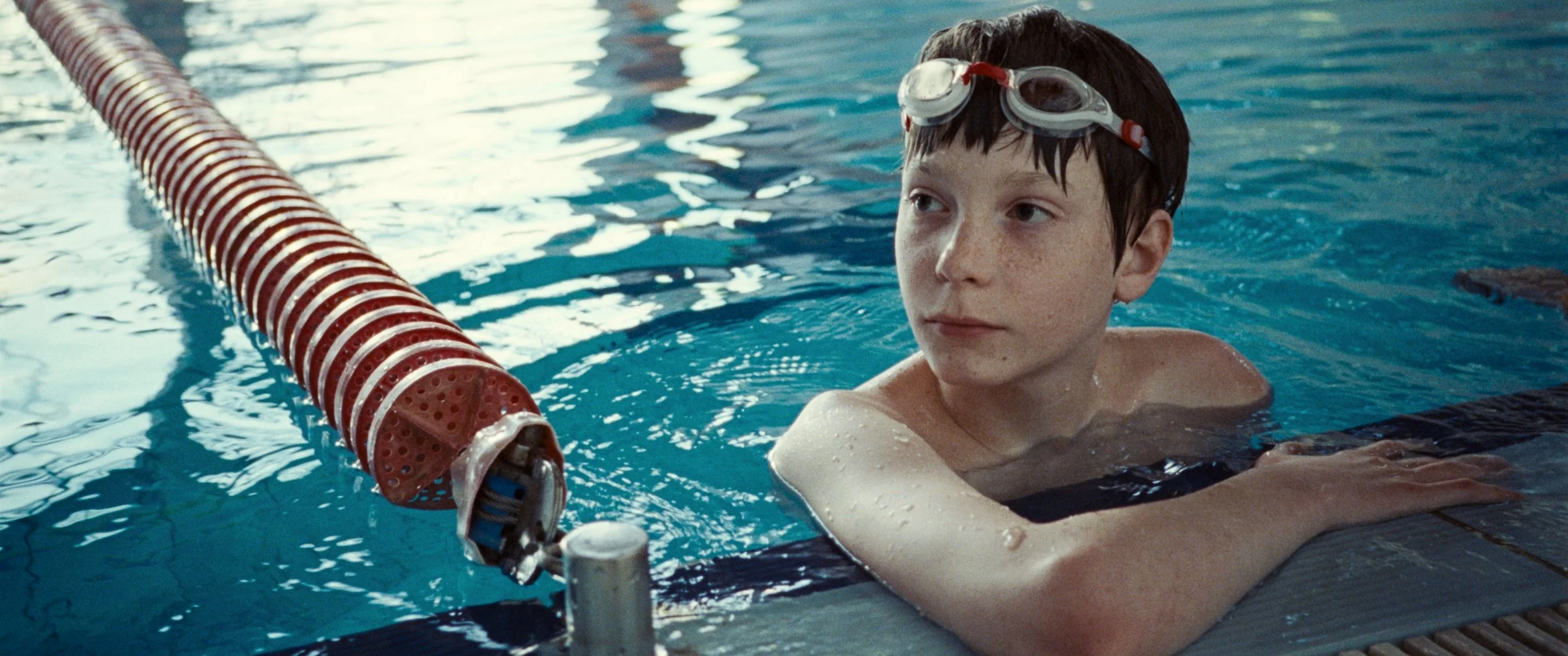
Courtesy of Steven Breckon. An Independent Film Company release.
The Plague centers on Ben (Evertt Blunck), an extremely anxious twelve-year-old boy who’s new to the water polo camp. Very quickly, he senses the power dynamic at play. Jake (Kayo Martin) is at the top of the food chain while Eli (Kenny Rasmussen) is at the very bottom, even lower than newcomer Ben. Jake tells Ben that the reason no one really talks to Eli is because he has the plague, a nonsensical ailment that Ben isn’t convinced is real. As the new kid, he finds himself torn between bullying with the cool kids and befriending the nice, ostracized kid.
The film takes place at a water polo camp, so the look of the pool is essential. It’s the main setting. So much action takes place within and around the pool that it has to serve the purpose for the sport, but also offer an interesting visual for the viewer.
“We looked all over the world for pools that felt like they were incredibly specific and had a certain visual feeling to them. I sent an email where I was like, best pools in the world. It was 20 pools in France, one in Ireland, one in Japan. Then we found one in Romania that could make sense. There’s an amazing pool with this team that plays polo there. They were going to the Olympics two summers ago for one week, so we had an opportunity to have it to ourselves.”
To shoot all the water/pool scenes in one week is hard enough when your actors are all adults. The Plague is primarily made up of children, so there are stricter laws about how long they can be on set and working. Polinger calls that week “insane,” but even that feels downplayed.
“Everett, who plays Ben, was sick at the beginning of the week. He couldn’t go into the water, so we had to take a day off and come back on Saturday. It was a very frightening week. It was also hot, like 100 degrees in this pool room. It’s very echoey and everyone’s jumping in the water whenever they can and trying to cool down.”
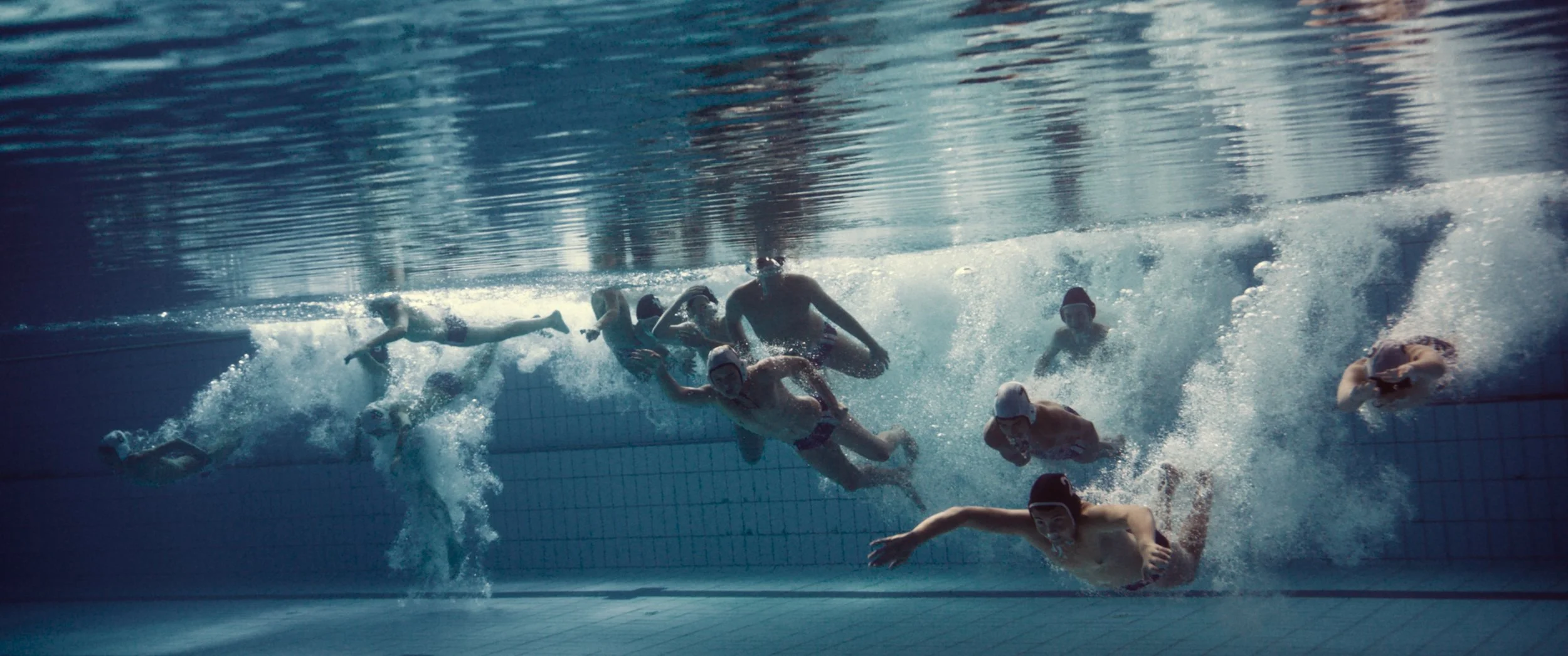
Courtesy of Steven Breckon. An Independent Film Company release.
While the rest of The Plague was shot on 35mm film, the underwater sequences were done with a digital camera. It was a practical choice for a few different reasons, according to Polinger.
“We wanted to be able to keep the camera rolling at all times while we were also shooting above water with two cameras. For most of the shoot, it was a one-camera thing, but for the water, we had three cameras going. We had one on a crane, we had one on a buoy that you put on the surface, and then we had the underwater one.”
“We really tried to plan out the exact order of things. We also tried to be responsible and start by doing all the actual scenes first. We didn’t want to leave that for the end, because you could spend as much time as you want doing all this water stuff. We knew we had to kind of get through the narrative chunks first and then do what we could with this amazing underwater team from Germany.”
The look of water polo in The Plague is almost gladiatorial. When the camera is underwater, it’s a mess of limbs pushing, fighting, brawling. These boys are fighting in the sport, but also as an extension of the social dynamics that are playing out above water.
“Steven Breckon, the DP, and I were looking at war tableau paintings and gladiator tableau paintings. Those giant ones you see that are the size of an entire building. It’s such rich detail and high contrast. Those paintings often feel very spatially disconcerting.”
“I thought water was an opportunity to do a version of that because it’s such unusual physics. Most of the time, I think underwater photography tries to lean into a very shallow focus and a very blue ray of light. We went the opposite direction. We blasted it with light and wanted to see everything. We wanted to actually bring out the skin tones and make it a lot warmer, less blue.”
“That created this painting-like quality. It was hard because we had to actually make sure the kids could play. I mean, it was like an action sequence in a way. We planned out the core of what we needed to capture. A week before shooting was teaching the boys water polo and working with a real water polo team and our actors together to choreograph the water polo scenes. Especially the final fight in the pool.”
Courtesy of Steven Breckon. An Independent Film Company release.
As much as The Plague is a drama, there are glimmers of a body horror movie in the margins of the film. Polinger cites movies like Carrie and Raw as inspiration for his debut, but also notes that most of these puberty-body-horror flicks center on the female experience. Films that focus on boys at this pre-teen age are more nostalgic. Sure, there might still be some strife, but the overarching feeling is a warmth for a time no longer present. The Plague doesn’t offer any nostalgia, and instead forces the viewer to reconsider the lasting effects the actions of teenagers have as they grow up. Not only that, it gives them a chance to reflect on the pain they endured.
“I know it’s easy to watch The Plague and feel like, oh, it’s really intense, it’s dark, there’s a lot of cruelty. I think there’s also a lot of empathy in the movie. When you see a movie about something really challenging, and maybe you’ve experienced some version of it in your life, it’s sort of put out there. You’re not alone.”
“I think that can feel very comforting. Or at least there’s a connection with that. I think that’s one of the great things movies can do in general. I often find really dark movies to be very soothing in a weird way. I think people who like horror films, war films, and dark movies will relate to that. It’s the feeling that you feel very alone, but after watching this movie, you realize you’re not so lonely anymore. The hope is that boys can watch it, that anyone can watch it, and maybe feel seen in some way. There’s something universal in it, I hope.”
One of the recurring moments of comedy in the film is a series of Would You Rather questions the boys pose to one another. It’s these moments where the audience remembers that, beneath their desire to fit in and the anger they feel at being rejected, they’re just silly pre-teen boys. One such example comes from Matt (Caden Burris): “Would you rather, A, every time you have an orgasm the song “All Star” by Smash Mouth plays? Or, B, every time the song “All Star” by Smash Mouth plays, you have an orgasm?” Polinger admits he could have written a whole movie solely filled with these silly questions.
“That was some of the earliest stuff I was writing. I’ve heard some really funny takes on these questions. I was just listening to a podcast where they were saying, oh, I could never pick the I-have-an-orgasm-every-time-I-hear-Smash-Mouth because I could never watch Shrek again. I thought that was an incredible take. I totally agree.”
support your local film critic!
~
support your local film critic! ~
Beyond the Cinerama Dome is run by one perpetually tired film critic
and her anxious emotional support chihuahua named Frankie.
Your kind donation means Frankie doesn’t need to get a job…yet.

Follow me on BlueSky, Instagram, Letterboxd, YouTube, & Facebook. Check out Movies with My Dad, a new podcast recorded on the car ride home from the movies.