
Lovell Holder Talks Time and Identity in Debut Novel “The Book of Luke”
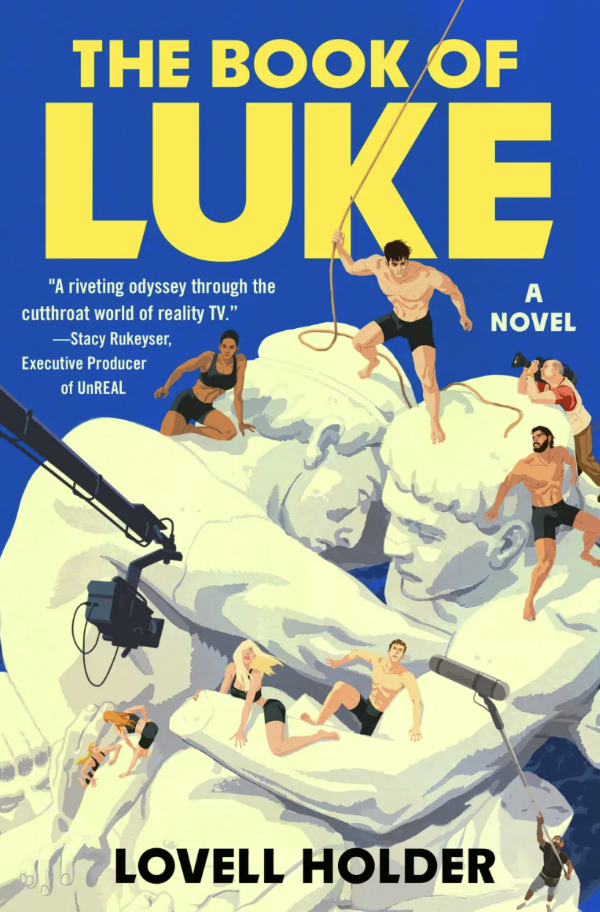
We are in the midst of a reality TV heyday. There’s a competition show out there that will have the ability to capture everyone’s attention. You want women throwing wine at each other at dinner? A smorgasbord. Competition for survival? You can have them clothed or naked and afraid. What about LEGO building? Shockingly, yes, there’s that too. Lifelike cake, chefs, plastic surgeons, butchers, tattoo artists, supermodels, bounty hunters…the list goes on. All of those listed have been the subject of a series of their own. Writer Lovell Holder is a lover of reality television, and it’s in this world of competition, identity politics, and national attention that he set his first novel, The Book of Luke.
Ten years after winning the competition show Endeavor, Luke Griffin’s world falls apart. He’s married to the first openly gay senator and they have two kids together, but their marriage is rocked by his husband’s infidelity. It’s at this moment when Endeavor comes back into his life. They offer Luke a staggering amount of money to return for the twentieth season and he’s in no position to say no. The Book of Luke jumps forward and backward in time, recounting his first appearance on the reality show as he returns to the place and the people who changed his life a decade ago.
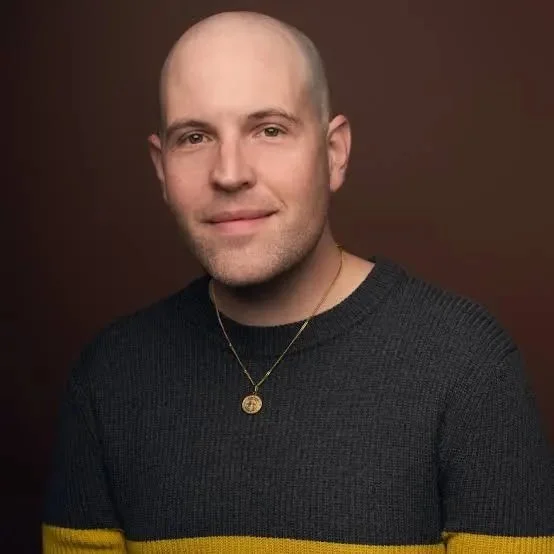
The Book of Luke is Holder’s first novel, but he’s no stranger to storytelling. He’s co-written two feature films, Lavender Men and Loserville, and produced festival favorites like The Surrender and Peak Season. The idea of sitting down to write a novel is immensely daunting for many people, but for Holder, it was freeing in an unexpected way.
courtesy of Lovell Holder
“The difference between writing a book and writing for film or stage is that you’re not having to write to a budget. A screenplay or a play is really just a template for another event. Whereas a book…that’s the motherlode, that’s the whole shebang. If you want to bring in a helicopter, that’s just one sentence as opposed to $500,000. Books allow for a sort of creative emancipation in that anything feels possible as long as it’s dramatically earned.”
“It was 2019 when I originally started the book. That pre-pandemic moment, I think for me professionally, I was just very uncertain about what was going on. I knew I was attached to direct a play that next year in LA, but I had all these film projects that had kind of stalled out at the time, and I was like, well, what can I really control?”
“Well, all that’s required for a book is me and my laptop. I had the initial seeds of an idea, and I was like, I think I’m going to start wrestling with this because even if I wanted to do the TV or film version of this, this would be such a mammoth budget. It would still be living on my laptop if I had tried to go that route. One day, I started writing. The pandemic threw me a little bit of a curveball because I’m very much a coffee shop writer. I have a hard time writing in my apartment, so I got two-thirds of the book done over the course of probably nine months.”
“Then came Covid, and then the final third took me 11 months to finish. Like getting blood from a stone. I think that time also ended up being a gift, because at the start of writing that story, I was really, really interested in the idea of complicity and exploring that topic. By the end, for a variety of reasons, even just how the country was shifting in that moment, I think I became much more interested in forgiveness.”
While the emotional arc changed throughout Holder’s writing process, what remained constant was the component of reality television. In preparation to write the novel, Holder took an old adage to heart. “Write the book you want to read.”
“If I wouldn’t pick it off a shelf then what’s the point? I’m mostly cooking with Crisco, as one of my friends would say, if it’s a subject I really feel rooted in and grounded in and enjoy. I’ve always been a big reality TV viewer. Coming from indie films, I don’t want to watch indie films when I get home at night. I want to watch something further from that. For me, that was always reality TV.”
“What’s most compelling about reality television, especially at this kind of stage in our culture, is that it has so many eras within itself. It’s not just creative eras within each show. Those eras actually reflect back kind of where American society was at that time, just even in terms of what voices are highlighted, how a certain character might be presented, what subject matter might be edited out.”
“Because I knew I wanted to tell a story about time and a person having to revisit who they were in a specific moment and trying to question, how have they changed? Can they change? What does it mean to do so in a fishbowl where there’s this wide cross-section of humanity? What else does reality TV give us but a truth that’s stranger than fiction? It throws all these people together that, just simply by all natural law, should not be meeting. That was the gift that I think reality gave me for telling this story about complicity and forgiveness, but I think it was also about time. All my favorite stories, when I look at the works of art that I really love in some way, are wrestling with time.”
The Book of Luke is a story that looks at reality television’s impact on our social consciousness, but it’s also a story of a gay man. When Luke competed on Endeavor the first time, he had been in the tabloids for being a rising-star football player who was openly gay. When he returns to Endeavor, he’s in the tabloids once again as the husband of the first openly gay senator who has been cheated on. What is it about queer people that makes them not only participate in reality shows, but also consume them?
“In the same way that maybe 30, 40 years ago, queer people would watch soap operas or the way that certain queer people would latch on to the Judy Garlands of the world, those high camp moments. I think one of the few places where you can still find sincere camp is in reality TV today.”
“In some ways, the question of what draws queer people to reality TV is maybe less about why do we like reality TV, but what brings queer people toward camp? As an art, a tone, and as a feeling. When I think of the majority of queer people in my life, all of them have a pretty damn good sense of humor. Maybe in some ways, that’s its own survival mechanism. When you’re in a community as an underrepresented group and you’re trying to find your place in whatever that society is, laughter and joy, however you seek that out, is a paramount tool that we all fall back on.”
“When you look at the figures in reality TV, whether that’s Housewives or even the Kardashians, that queer people might latch onto, all of the big-ticket players do have a pretty good funny bone. Their self-awareness might be on a sliding scale, but in addition to whatever high drama they’re bringing, there are also some good one-liners. I think a great example is someone like Erika Jayne on Real Housewives of Beverly Hills, where even as she’s going through these moments that are objectively Greek tragedies, she can still put on a dramatic outfit, sell a line, and be a show woman. There’s something innately compelling about the marriage of so many different things.”
“A lot of queer people respond to works of art that contain multitudes and layers. All good reality TV does that. Real Housewives can kind of be vapid consumerism, but it’s also a documentary of how money moves in American society, and what people of a certain net worth choose to invest in and choose to chase. I remember reading an article, probably ten years ago, around the 10th anniversary of Real Housewives of Orange County. It was the first article that basically said, this show will be remembered as the documentary that captured the 2007–2008 financial crisis. One of those women, I believe her name was Lynne [Curtin], all of a sudden she goes from living outside her means, hocking her jewelry to the next episode where the camera crews are trying to get into her house. She will not let them in because they’re about to have to move because they can no longer afford that house.”
At this current state of American history, it’s unrealistic and dangerous to continue to write off reality television as a mindless piece of media that has no effect on our society. The current president is a former reality TV host and is essentially running the country like he’s back on The Apprentice. Holder is adamant that reality TV is politics.
“Reality TV and politics have become totally enmeshed. There’s no way to take them apart. For better or worse. Many times worse. Take The Challenge. It was very much a show in the back of my mind while I was working on this. In the first episode of The Challenge that aired in the late ’90s, within the first five minutes a young man named Sean Duffy from the Real World Boston meets his wife. Now Sean Duffy is our Secretary of Transportation. He’s also a two-time Challenge champion.”
“When that guy meets his wife and they go on to have all these kids…that first moment is captured on camera. That’s an indelible fact. Would he have ever even gotten to this place had he not had that platform to begin with? Reality television is a major cultural force, right? Like many things in contemporary society, you discredit it at your own peril.”
courtesy of Talkhouse
A main component of all reality television, no matter the format, is the notion that a participant almost has to sell their identity to justify their presence on the show. Viewers hear of participants who are on competition shows because they need the money for a loved one’s medical bills. There’s a very thorny, thin line between reality TV as a tool to introduce people to a way of life that’s so different from their own and behind-the-scenes exploitation by producers to craft a show that will bring in the most viewers.
“I think back to the subject of time. There’s a big difference between going on reality TV in the early 2000s and going on in 2015, when the bulk of the book is set. Unless you’ve been living with the Amish, how do you go on reality TV in this day and age and say, I can’t believe they showed that. It’s like, well, were cameras rolling when you did it? You kind of knew what you signed up for. I do think the exploitation factor gets less and less with time. I think if you were signing up for that now, I do think the gloves are off.”
“I think back to something a dear friend of mine said. She’s an actress; very, very talented. I won’t use her name to protect her privacy, but she was on a reality show very early in her career. It was a talent competition. I was casting a film, and I had seen her on this show. Part of the reason I called her was because her talent had been without question on the show.”
“I asked her later, because she had been presented as one of the more prickly characters and that was not my experience of her at all when I met her. I asked her, just out of curiosity, how was your experience on the show? Do you think you were presented accurately? Her response was, oh, you’re asking why I got the bitch edit. She’s a marvelously frank person and very candid. She said, well, we filmed for two months and I had two really bad days. They were just two days, but they did take some of that and sprinkle it in every single episode of the show.”
“But she said, here’s the thing, did I give them the footage? I absolutely did. Every single minute of it. I can’t blame them. No one put a gun to my head. I did it. Consequently, I thought that was a very mature understanding of like, yeah this isn’t me, but I did give them the raw materials.”
“I think back to something Andy Cohen said on one of the Housewives reunions. It’s actually one of the few lines that I did directly incorporate into the book. There are three or four little soundbites that are there as Easter eggs. Andy was saying to, it might have been the Vanderpump Rules cast, he said, you’re all in power of your own actions. That was something that did resonate because I do think we’ve moved away from the days of them willfully trying to get people as drunk as possible. Anyone on The Challenge will tell you, it’s rare they get more than two drinks on a given night.”
“I do think sometimes it’s up to the person to say, even if this is exploitative, how do I turn it into a platform? I think Zeke Smith, who was on Survivor and who is outed as trans on the show, I respected tremendously the ways in which he took that. In the spirit of Beyoncé, say when life gives you lemons, make a Grammy Award-winning album. Zeke really pivoted. It’s like, okay, if I am being handed this moment, how do I use this as a way to foster a conversation in society in a different way?”
“And boy, did he. He’s on the board of GLAAD now. It’s also like, how do you take these things and find ways of owning them? You could sit and bemoan or you can move life forward. I think that’s true of any profession, anything in life. I do sometimes think that opportunity and happiness are choices as much as anything.”
Since Holder is such a reality TV buff, it feels only right to end the conversation by asking which reality show he thinks he could win. Without hesitation, he says he could win Big Brother, but psychologically, he couldn’t handle it. Why? He lives five minutes from where it films and knowing that his home and nice, comfortable bed were a quick walk away would be impossible to overcome.
“If I was on Traitors, and I was a traitor… I won’t say it here so I don’t jinx myself, but I do think I have a strategy that I have not seen done before. I’ll put it this way. It might not get me as a traitor to the end, but I guarantee you at least someone who was a traitor would win. I would go on Traitors in a heartbeat. It’s too fun.”
Follow me on BlueSky, Instagram, Letterboxd, YouTube, & Facebook. Check out Movies with My Dad, a new podcast recorded on the car ride home from the movies.
Support Your Local Film Critic!
~
Support Your Local Film Critic! ~
Beyond the Cinerama Dome is run by one perpetually tired film critic
and her anxious emotional support chihuahua named Frankie.
Your kind donation means Frankie doesn’t need to get a job…yet.