
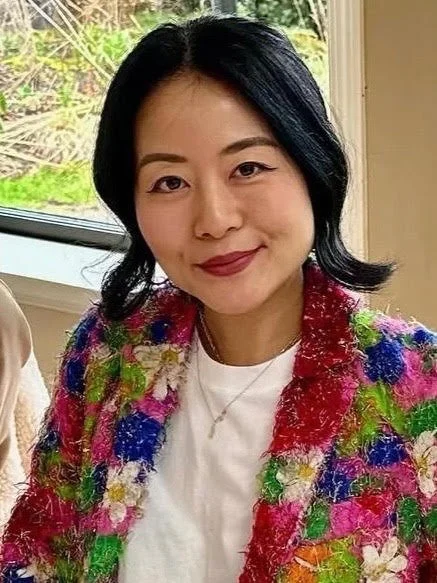
Before Tammy Joe got into the world of costume design, she found herself working in education, medical consulting, vintage restoration, and in-home staging. While a more circuitous route than many would take for this career, Tammy Joe always knew that clothing was something she was passionate about. She studied apparel design and came into the world of film and television by way of props through her in-home staging job. That first job working in props fell through, but it gave her the push she needed to pursue costuming.
Courtesy of Tammy Joe
“The moment I came into film and started working in costumes, it almost felt meant to be a part of my journey. I studied psychology and history in school. One of the most important approaches I take when I’m working on a character is to try to understand the mindset of why, when they get up in the morning, they put on what they do. What that means to them, and how it speaks to the life they lead.”
Tammy Joe describes clothing as having its own emotional architecture. She sees outfits not as necessary to clothe someone, but as a means of expression in the smallest detail. Even people who choose a wardrobe that’s easy and doesn’t force them to put together intricate outfits are expressing themselves in their own way.
“Clothing really can shift how you feel in your everyday life. What you wear and how you wear it often shifts how you feel. People very intentionally dress a certain way to elevate or comfort their state of mind.”
“When I approach a character and the closet I want to build for them, I like to start with who the character is, what they’re trying to say. Are they people who want the world to notice them or do they want to disappear? What does that mean in terms of, not only what they choose to wear, but how they choose to wear it? It reflects a lot of the emotional mindset of the wearer.”
“In a project I just recently wrapped, one of the things we talked about is how the clothing was meant to be very comforting to the character. We left sleeve lengths intentionally very long, and we wore down the inside because the actor started rubbing the inside of their sleeve with their fingers to create a comforting action. That was something that became part of the character and all the pieces of the character.”
“Regardless of whether it’s something that’s noticed on camera or on screen, I think it means a lot to the actor in their performance. When they have the ability to connect to something and they feel the character through what they’re wearing, they get to do the motions of the character through the pieces they’re wearing. It becomes more than just a costume. It starts to inhabit the essence of who they are as people.”
“That’s really the ultimate goal when we’re selecting pieces of clothing for a character — that it fully integrates with who they are and it doesn’t feel like they’re wearing something, but it’s actually just something that feels like a part of them.”
Tammy Joe’s costume design work can be seen in Mike Flanagan’s adaptation of Stephen King’s Carrie on Prime Video. Unlike previous iterations, Flanagan elongated the story into an eight-episode miniseries that was recently greenlit for a second season. Despite the change in length, the story stays relatively the same. Carrie (Summer H. Howell) has grown up in a sheltered manner with her mother (Samantha Sloyan) telling her of the horrors of the rest of the world. After the sudden death of her father, Carrie is forced to attend public high school for the first time, where she finally comes face-to-face with the world her mother warned her about.
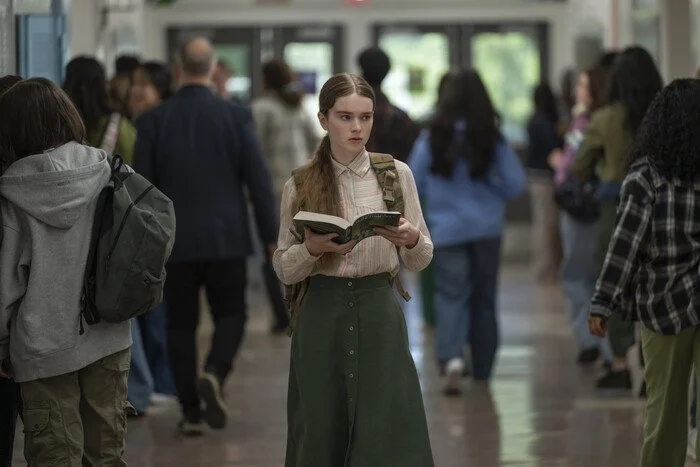
Carrie is torn between the conservative world she’s known her whole life and the taste of freedom that comes with going to school. Carrie has to make all the clothes she wears from fabrics she’s found around the house. There’s a harsh contrast between Carrie’s homemade clothes and the off-the-rack items her fellow teens wear. For Tammy Joe, this meant playing with the contrast between the two worlds Carrie finds herself in.
“When Carrie goes to school, her pieces are homemade. They feel very traditional in terms of the world she was brought up in. The high school world around her is of the contemporary time period. There’s a juxtaposition when these clothes are next to each other. They work together in the sense that they’re supposed to feel deliberately very different.”
“Later on, when Carrie gets a shirt from the lost and found, that’s her bringing something from the outside world home. That’s the first time you see the two worlds become cohesive and collide. She takes her lost-and-found look and then she remakes it into something with pieces from her home and her life, and then kind of blends the two in an attempt to fit in with the outside world.”
“With Carrie and her costumes, as she starts to slowly integrate and her world starts to broaden, she’s influenced by Emaline (Thalia Dudek). Her silhouette slightly changes. Everything still feels very Carrie. We don’t see drastic shifts, but we do see an adaptation of her pieces from homemade to also include what she sees in the outside world.”
Courtesy of Prime Video
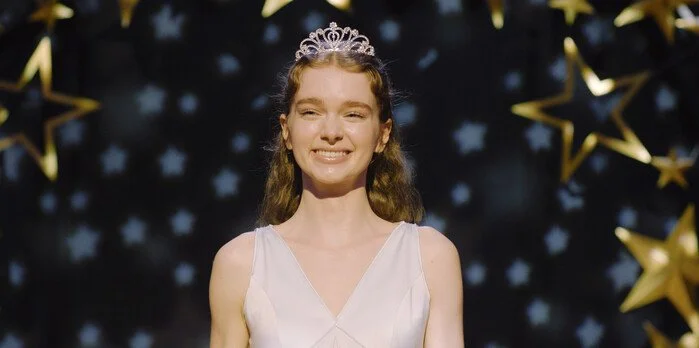
If there’s one singular image that people think of when they picture Stephen King’s Carrie, it’s the moment at prom when Carrie is covered in blood. Brian De Palma’s 1976 adaptation is perhaps the most famous, and even those who haven’t seen it can picture Sissy Spacek as the titular Carrie in her prom dress. With such an iconic moment, Tammy Joe, along with Flanagan and his team, had many discussions about what this new iteration of the dress would look like.
“It was very intentionally tied to and inspired by DePalma, as many versions of Carrie have been. When I came on board, I worked with Summer, and we really wanted to refine and make it feel like something that was clean and contemporary. Something that worked with all the action and the movements of the scene.”
“Finding small, finite details that made it feel slightly more modernized, but with a very classic silhouette, was important. There were so many things, down to the little details in the shoulder, the ruching, the piping that we did, just finding ways to create a slightly more contemporary world without shifting the main vision of the nod to the original.”
One of the common refrains from those who have worked on one of Flanagan’s projects is that he approaches every aspect of the work with passion and honesty. From Flanagan’s writing to the artisans who bring those words to life, everyone is encouraged to let vulnerability lead their decision making. Carrie marks the first time Tammy Joe has worked with Flanagan, but she says that his openness was evident from the start.
Courtesy of Prime Video
“I very quickly learned that Mike is so deeply dialed into every single detail and thought process of the characters he creates. Everything is done with such incredible care and intention, and that is definitely something that elevated my process. It absolutely is something that’s infectious.”
“In every fitting with Sam and Summer, we talked about the origins of the pieces. With Summer, we would talk about where the fabric would have come from in the house. This was something that started at the helm of how Mike approaches the world of his projects, and something we very quickly were inspired by and wanted to run with.”
“When you work at that level, you only want to dive in deep and elevate everything you do as a result. It really made me, in my own approach, dig as deep as I could. A lot of the pieces throughout the entire show, not only on Carrie and Margaret, but on Christina (Alison Thornton) and Sue (Siena Agudong), we did a lot of custom dying. A lot of it was to speak to the levels we wanted to reflect. The intensity of colors, the saturation of colors, the dullness of colors — we really wanted to reflect the emotional state.”
“All of that came from trying to meet the levels of the emotion and the thoughts that were being put across on every level, from directors, from Mike and his team, from the actors. There’s so much vulnerability and passion. That’s really what elevated and enriched my process.”

Follow me on BlueSky, Instagram, Letterboxd, TikTok, YouTube, & Facebook. Check out Movies with My Dad, a podcast recorded on the car ride home from the movies.
Support Your Local Film Critic!
~
Support Your Local Film Critic! ~
Beyond the Cinerama Dome is run by one perpetually tired film critic
and her anxious emotional support chihuahua named Frankie.
Your kind donation means Frankie doesn’t need to get a job…yet.