
“No Other Choice” is Park Chan-wook Firing on All Cylinders
The state of the job market is bleak. In November 2025, the unemployment rate in the United States was at 4.6%. Percentage-wise, that doesn’t sound too bad, but that’s 7.8 million people looking for work. The November 2025 rate is .1% off what it was in 1997 when Donald E. Westlake wrote his horror-thriller novel, The Ax. The novel was adapted in 2005 and has returned to the big screen this year as No Other Choice under the masterful eye of Park Chan-wook, who moved the film’s setting to South Korea. Unemployment is a worldwide problem, and No Other Choice shows what happens when desperation turns to furious action.
Man-su (Lee Byung-hun) is an expert in a dying industry. The world of paper goods is not what it once was because so many of the cornerstones of the industry, like magazines, have withered away. When we first meet Man-su and his family, he’s grilling eel, a luxury according to his wife, Mi-ri (Son Ye-jin). They have two children, Si-one (Kim Woo-seung) and Ri-one (Choi So-yul), and two dogs. All is well for the family until an American company buys Man-su’s employer and he loses his job. After thirteen months of no prospects, Man-su decides to take matters into his own hands, with violent outcomes.
The phrase “no other choice” is repeated throughout the film by multiple characters. From Man-su to his former employers to his family members, there’s a chorus of individuals who feel they’ve been backed into a corner and have no options. Anyone who’s looked for a job recently, with the rise of AI, will tell you that things are exceptionally dim. Technological innovations promised to make life easier, but that’s not what’s happening. AI is taking jobs from the lower and middle classes so those at the top can profit even more. Where does that leave people like Man-su? People want to work, it’s just part of human nature. Most want to do something that feels honest and productive. They want to contribute to the wellbeing of themselves and their families. No one wants to be worked to the bone for the sake of their employer, but there’s a happy medium where people can work and have a meaningful life outside the company. It’s unconscionable that someone can work 40+ hours a week and not afford to live. No Other Choice is an example of what happens when an individual’s sense of purpose is stripped from them. It demonstrates the anger with the path our society is on, where only a select few are given a real choice.
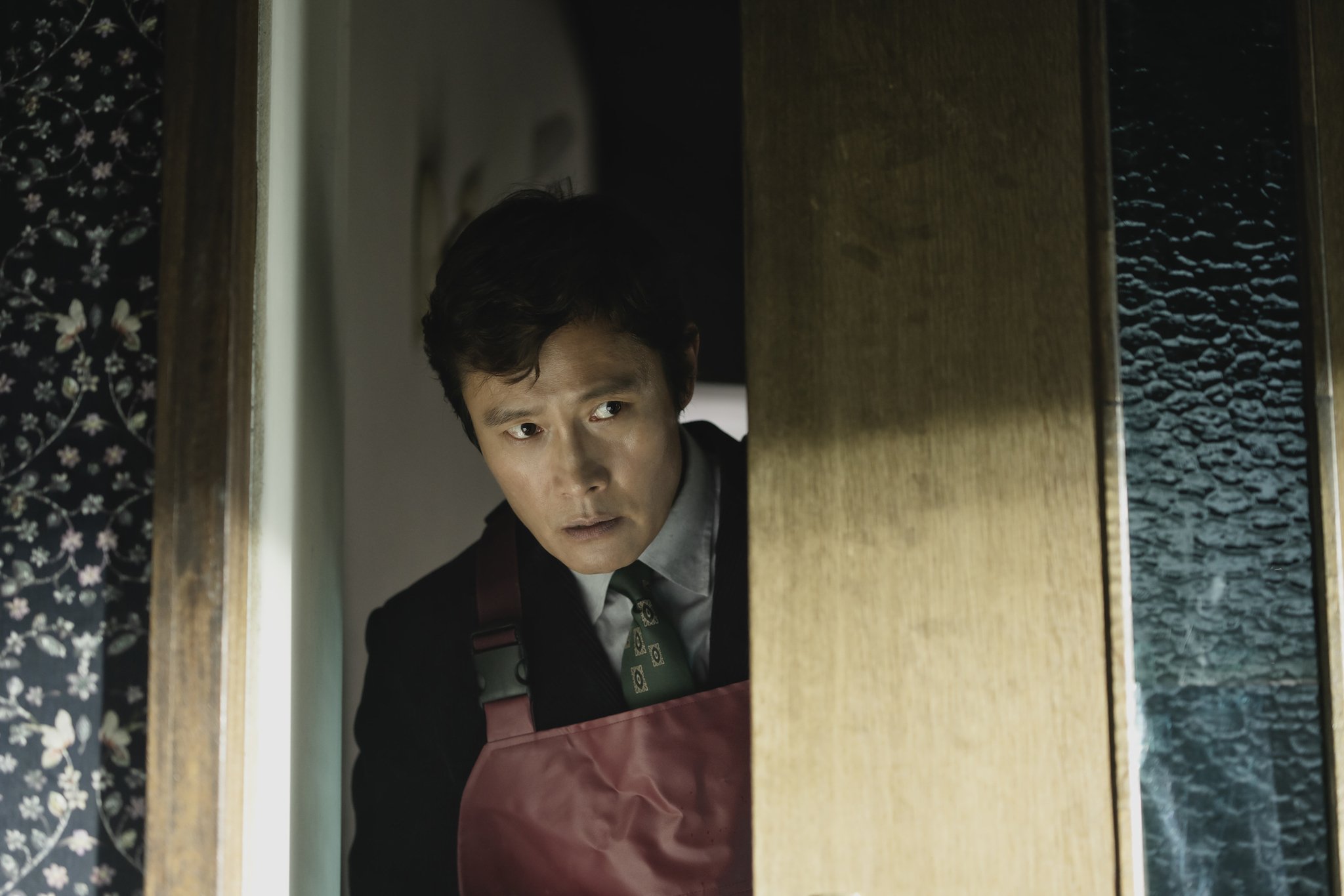
courtesy of NEON
In some ways, No Other Choice and Marty Supreme are like two sides of the same coin. Both are about desperate characters trying to keep their heads above water as the waves get rougher. They offer a series of events that starts with a small choice and snowballs into something larger. Despite the similarities, watching the films within days of each other highlights the fact that Chan-wook has a much better grasp on what can be described as “desperation odyssey” cinema. The series of escalating events in No Other Choice comes across as organic, an illogically logical collection of choices that are fueled by the rising waters of defeat. In Marty Supreme’s case, the escalations feel disconnected, as though the wild situations were created first and the threadbare connections were afterthoughts. No Other Choice is magnificent in its ability to take an extreme route that remains rooted in a hopeless sense of reality.
Chan-wook and cinematographer Kim Woo-hyung are on another level with their work in No Other Choice. Editing tools like transitions and superimpositions have gone out of style, and in most instances these choices immediately date the film. Chan-wook, however, has breathed new life into the power of a transition. While filmmaking is a visual language, few movies really push the limits of that definition. It’s like watching the artform be reinvented in the modern era, and how lucky we are to be able to see Chan-wook work.
No Other Choice is a mountainous piece of filmmaking. At times darkly funny, at others horrifyingly real. There’s violence at the center of the movie, but it’s not just blood, guts, and gore. The way capitalism has structured our society is its own type of violence, as are the effects of miscommunication. No Other Choice is a thriller, yes, but it’s also a profoundly sad retrospective on the state of the world today.

Follow me on BlueSky, Instagram, Letterboxd, TikTok, YouTube, & Facebook. Check out Movies with My Dad, a podcast recorded on the car ride home from the movies.
support your local film critic!
~
support your local film critic! ~
Beyond the Cinerama Dome is run by one perpetually tired film critic
and her anxious emotional support chihuahua named Frankie.
Your kind donation means Frankie doesn’t need to get a job…yet.