
“Peter Hujar’s Day” is Gentle, Quietly Staggering
Ira Sachs’ Peter Hujar’s Day premiered at the 2025 Sundance Film Festival and has since had a limited theatrical run in the United States. It is, after all, a distinctly New York story. Sachs described it to IndieWire as "a film about what it is to be an artist among artists in a city where no one was making any money.” The 1970s New York of Peter Hujar’s Day is long gone, Disneyfied and commercialized into a place Peter would likely no longer recognize. For seventy-six brief minutes, however, that version of the greatest city in the world comes back to life on sparkling, gritty film.
Writer Linda Rosenkrantz (Rebecca Hall) had an idea for a book. She thought it would be interesting if she spoke with her artist friends about the reality of their day-to-day lives. On December 19, 1974, Linda recorded an interview with Peter Hujar (Ben Whishaw), a photographer. Linda wouldn’t end up writing this book, and the tape from that day would go missing, but in 2019 a transcript of the tape was found in the Hujar Papers at the Morgan Library in New York. Peter Hujar’s Day takes this transcript and reimagines what that day would have looked like for Peter and Linda.
The concept of Peter Hujar’s Day is the cinematic equivalent of watching paint dry. It’s in the vein of Jeanne Dielman, 23, quai du Commerce, 1080 Bruxelles, except that instead of actually seeing Peter go about his day, the audience is witness to him as he recounts it to Linda. All this to say, it’s a marvelous little piece of filmmaking. So much of life can be summarized to exactly this: a person retelling their steps to someone else. Sometimes the conversation strays or wanders to another topic, but then it swirls back to the events of the previous day.
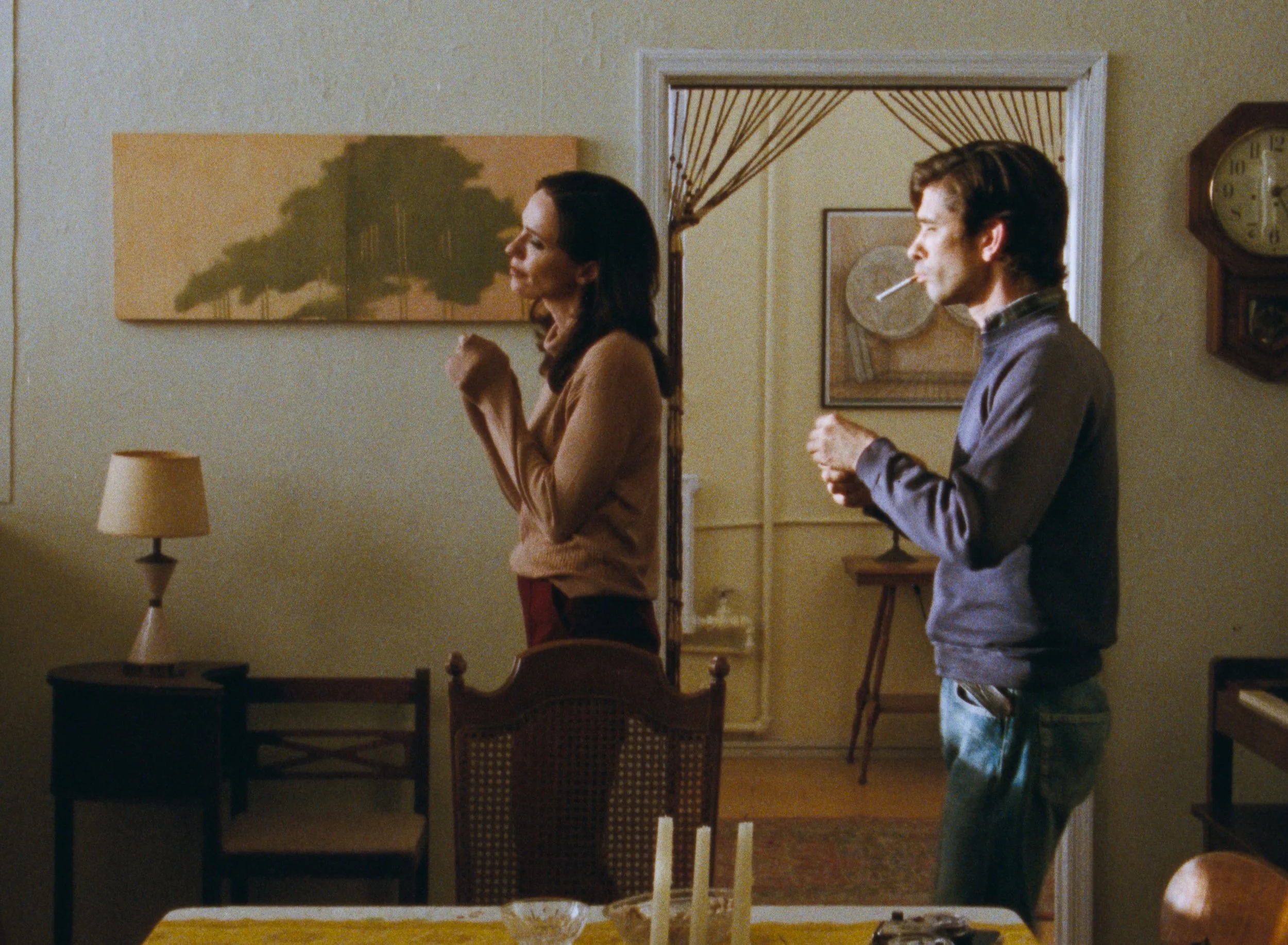
Ben Whishaw and Rebecca Hall in Peter Hujar's Day directed by Ira Sachs, Courtesy of Janus Films
To say that Peter Hujar’s Day is more akin to a podcast than a film is to not appreciate the wonder that is happening within the confines of the frame. Hall and Whishaw are so attuned to these roles that they disappear into Linda and Peter. It feels like friends hanging out, artists commiserating, and people just trying to make sense of creating art in a world that doesn’t want to pay them. In that regard, things are still frustratingly similar for artists of any discipline. Peter Hujar’s Day begs to exist in a visual format. The way the sun starts so boldly, only to shrink to a tiny sliver at the end. The apartment is both confining and freeing, but our characters also escape to the roof that overlooks their great city. The audience needs the visuals to understand the film’s central premise, which goes back to Linda’s original idea for the book.
What Peter Hujar’s Day and Linda are compelled by is the passage of time. What a day means in the life of another person. Don’t we all have this crushing insecurity that we’re wasting days? Can we look at the mundane details of the down-to-the-minute goings-on of another person and see that our boring nature is also essential to being alive? At a point early on, Peter asks if his narration of yesterday’s events is boring. Linda replies simply, “No, it’s not boring to me.” Maybe we’re all cursed to find our own mundanities to be uninteresting, or maybe we can only understand their importance when we share them with others. Peter Hujar’s Day is gentle, a warm reminder of life’s ebbs and flows.
support your local film critic!
~
support your local film critic! ~
Beyond the Cinerama Dome is run by one perpetually tired film critic
and her anxious emotional support chihuahua named Frankie.
Your kind donation means Frankie doesn’t need to get a job…yet.

Follow me on BlueSky, Instagram, Letterboxd, YouTube, & Facebook. Check out Movies with My Dad, a new podcast recorded on the car ride home from the movies.