
SXSW '26: Forbidden Fruits isn't Tart Enough to Have Bite
This review was originally published on Film Obsessive.
A certain generation of teenage girls was shaped by Diablo Cody’s sharp, dark writing. Jennifer’s Body was misunderstood by the general population, but a subset of weirdo teen girls (me) saw it as a generational film that was wholly unique. If you were to read the synopsis of Meredith Alloway’s SXSW-premiering Forbidden Fruits, it would sound like something Cody might’ve cooked up, so it’s no surprise to see her name pop up as one of the producers. More candy-colored than Cody’s works, Alloway’s film channels the rage of womanhood and desire, so frequently explored by Cody, into the bygone world of mall culture.
The Fruits are introduced much like the Plastics from Mean Girls, and since Forbidden Fruits was shot at the same mall as Mean Girls, that doesn’t feel coincidental. Apple (Lili Reinhart), Cherry (Victoria Pedretti), and Fig (Alexandra Shipp) walk through the halls of the mall with their Stanley cups and an air of superiority. There are hushed whispers about the legend that is the Fruits, and it’s clear that while they work at the mall, they also make it work for them. They’re the employees of Free Eden, certainly not a ripoff of Free People. If the Fruits sound like a cult, it’s because they are. They only accept girls who have fruit names into their witchy coven. When they meet Pumpkin (Lola Tung), a new employee at a pretzel shop certainly not modeled after Auntie Anne’s, they decide to open their arms and welcome in a new Fruit.
Forbidden Fruit takes place entirely inside the mall or in the parking lot. It never feels claustrophobic, but anyone who has worked retail will tell you that huge places like a mall feel both cavernous and small. The mall is an ecosystem all its own. A city that exists within the winding wings of shops. There’s food, entertainment, commerce, and a police/security force. Mall culture may be a thing of the past, but Forbidden Fruits returns it to its former glory. There was nothing more freeing or cool than to go to the mall unsupervised. It’s a place of popularity that thrives on inclusion and exclusion. Stores like Free Eden, and those who work there, sell an idea along with the tangible clothes. They want the customer to feel self-conscious and believe that only the clothes of Free Eden can ease their isolation.
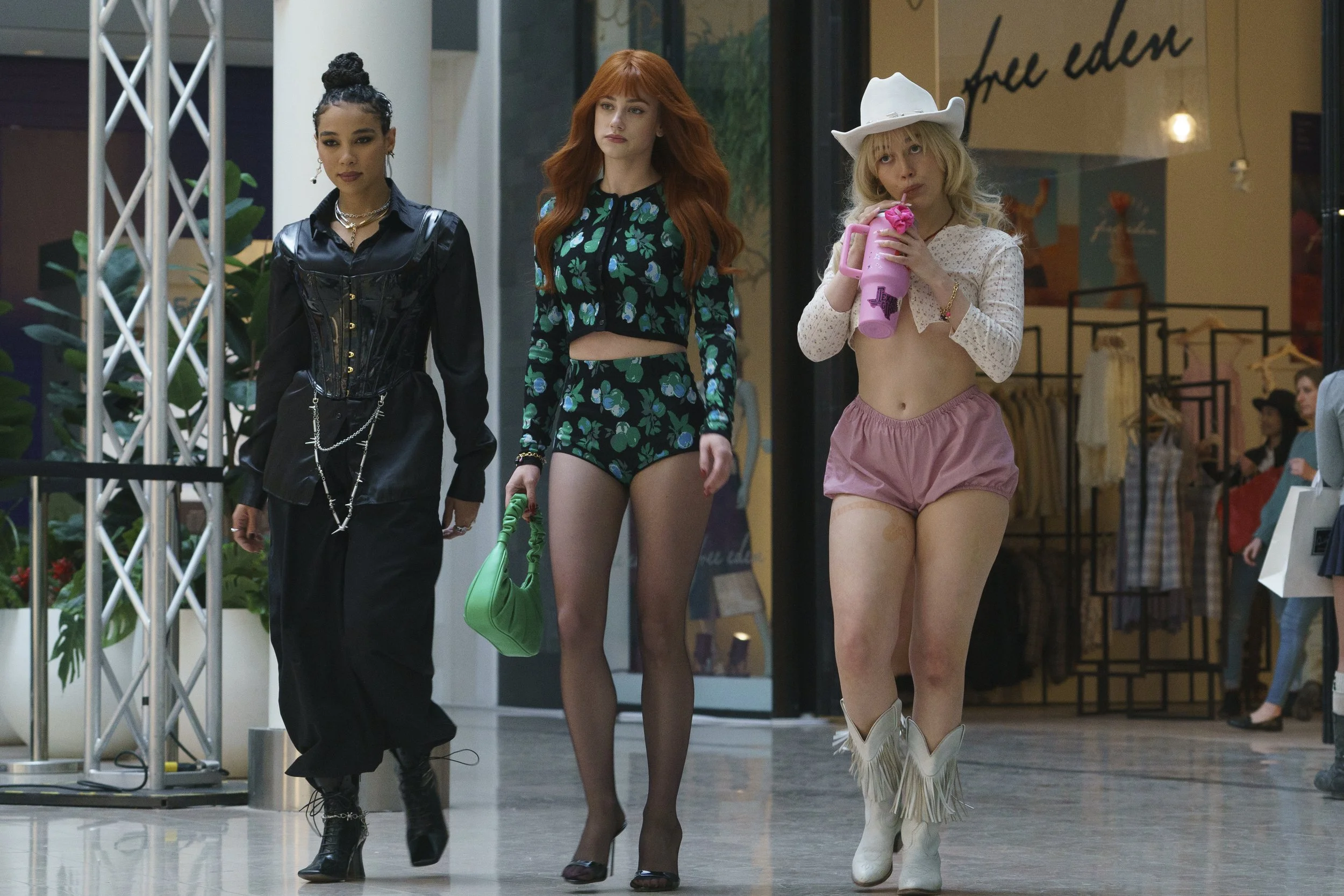
Credit: Independent Film Company and Shudder
That’s what draws the Fruits together, a yearning for community and sisterhood they’ve struggled to find elsewhere. To those who are struggling with their self-worth, nothing feels as good as being included, even when that inclusion has some drawbacks. That’s easy to overlook when the other option is loneliness. These women know that feeling of isolation all too well, so they’re willing to accept strange quirks of Apple’s leadership, like drinking blood from a cowboy boot. As girls are wont to do.
The four are quite a messy, fiery bunch. Reinhart’s Apple is angry, domineering, and very much needs to be in control of the situation. If we’re making Mean Girls comparisons, Apple is Regina George, Fig is Gretchen Weiners, Cherry is Karen Smith, and Pumpkin is Candy Heron. The Plastics are the archetype that the Fruits were based on, but they are not a complete copy. Each of the Fruits is distinctly funny in her own way, but it’s Pedretti who steals the show. A kindhearted, airhead performance that would make Amanda Seyfried proud. When the dialogue is snappy, it’s on fire. The quick-tongued barbs hurling from Fruit to Fruit are daggers that will hit your funny bone hard.
There are stretches of the film, though, that feel like filler. Montages of stores in the mall and a subplot of the Fruits fleecing customers are examples of scenes that slow the film’s pace. What makes this type of movie become the enduring legend of something like Mean Girls is the pace. Things have to keep moving to keep the film light. Its biblical themes of desire aren’t that heavy, which is why the dark humor works as well as it does. A film like Forbidden Fruits has to be as ruthless in its editing as its characters are with each other. The Fruits are missing the thorns that would make the movie dig into the viewer. It’s airy, bubbly, and darkly weird at times, but it’s missing that sensation as a through line. Forbidden Fruit is building to a bloody conclusion, but even then, it feels like an afterthought. The ending makes sense in the grand scheme of things, but it’s missing the connective tissue that would make it feel earned. Forbidden Fruits has the pieces of a cult classic, they just belong to different puzzles.

Follow me on BlueSky, Instagram, Letterboxd, TikTok, YouTube, & Facebook. Check out Movies with My Dad, a podcast recorded on the car ride home from the movies and I Think You’ll Hate This, a podcast hosted by two friends who rarely agree.
support your local film critic!
~
support your local film critic! ~
Beyond the Cinerama Dome is run by one perpetually tired film critic
and her anxious emotional support chihuahua named Frankie.
Your kind donation means Frankie doesn’t need to get a job…yet.