
“Watching Mr. Pearson” is a Love Letter to Legacy
Many people are afraid of growing old. Of what happens when their body is no longer able to do what it used to be capable of. It’s a reality adjustment, one that many struggle with because it can be hard to accept that the freedom they once had no longer exists. That’s the inherent push and pull of Dillon Bentlage’s Watching Mr. Pearson. It’s a story that crosses generations and asks what happens when you reach the end of the line. Who will be there for you?
When Watching Mr. Pearson begins, the image is black-and-white and grainy. There’s an old-Hollywood quality to the picture on screen and, for a moment, the viewer wonders what they’re watching. Is this a genuine movie from the ’50s? And who is Robert Pearson ()? The answer to that, once upon a time, was a Hollywood heartthrob. Today he’s confined to his New England home, bored, running out of money, and alone. His main relationships are with his two in-home caretakers, Caroline (Dominika Zawada) and Miguel (Luis Miguel Garcia Rizo). When the past and the present become too blurry to distinguish for Robert, glimpses of who he once was return to the surface.
There’s a distinct styling to the films of old Hollywood. Not just in the composition of shots, but in the characteristics of the actors and how they hold themselves. It’s often easy to distinguish between a true movie from that era and a modern filmmaker’s attempt to capture the essence. The opening shots of Watching Mr. Pearson blur that usually easy distinction. You might wonder to yourself if Robert Pearson ever shared the screen with Paul Newman. That’s how real it feels. As the characters watch Robert’s old movies, they, and the audience, are treated to a walk down the memory lane of the Hollywood of yesteryear. A dance sequence late in the film is hauntingly emotional as a blend of who Robert once was and who he is now. They cannot be more at odds with each other, but Robert struggles with that.
Courtesy of Watching Mr. Pearson
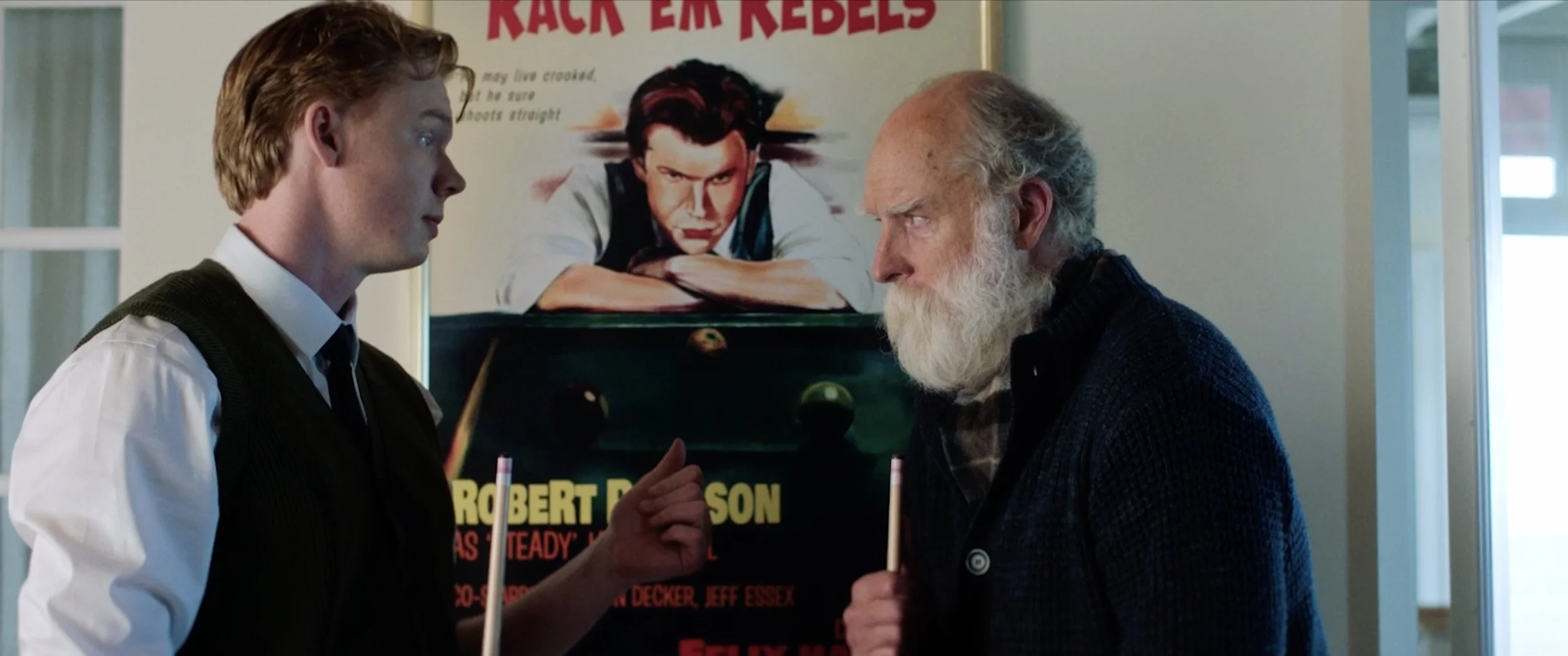
It’s a hard thing to accept that the way you envision yourself and the way you actually are don’t often line up. In Robert’s mind, he’s still the beautiful young actor who was utterly captivating on the big screen. In reality, he has dementia, requires supplemental oxygen, and can no longer take care of himself. There’s a scene where these two versions of Robert play pool together. The younger Robert is in a movie about a pool shark, perhaps a nod to Paul Newman’s The Hustler, and the way the two of them regard one another is fascinating. Older Robert is both jealous and frustrated with his younger self, while young Robert can’t believe his life will end up like this — as a “man who’s already done all of his living.”
Watching Mr. Pearson is a reflection on identity and the pursuit of something larger than oneself. When does this pursuit overshadow personal connections? Is it worth sacrificing that to have your name in lights for all those decades? Watching Mr. Pearson is quietly lovely in its understanding of our world’s messy emotions. It’s not a film about crafting a legacy, not in the larger sense, but about a legacy in our own connections. Watching Mr. Pearson is about loving the pursuit of something rather than attempting to craft a perfect legacy that remains long after you’re gone.
Follow me on BlueSky, Instagram, Letterboxd, TikTok, YouTube, & Facebook. Check out Movies with My Dad, a podcast recorded on the car ride home from the movies.
support your local film critic!
~
support your local film critic! ~
Beyond the Cinerama Dome is run by one perpetually tired film critic
and her anxious emotional support chihuahua named Frankie.
Your kind donation means Frankie doesn’t need to get a job…yet.