
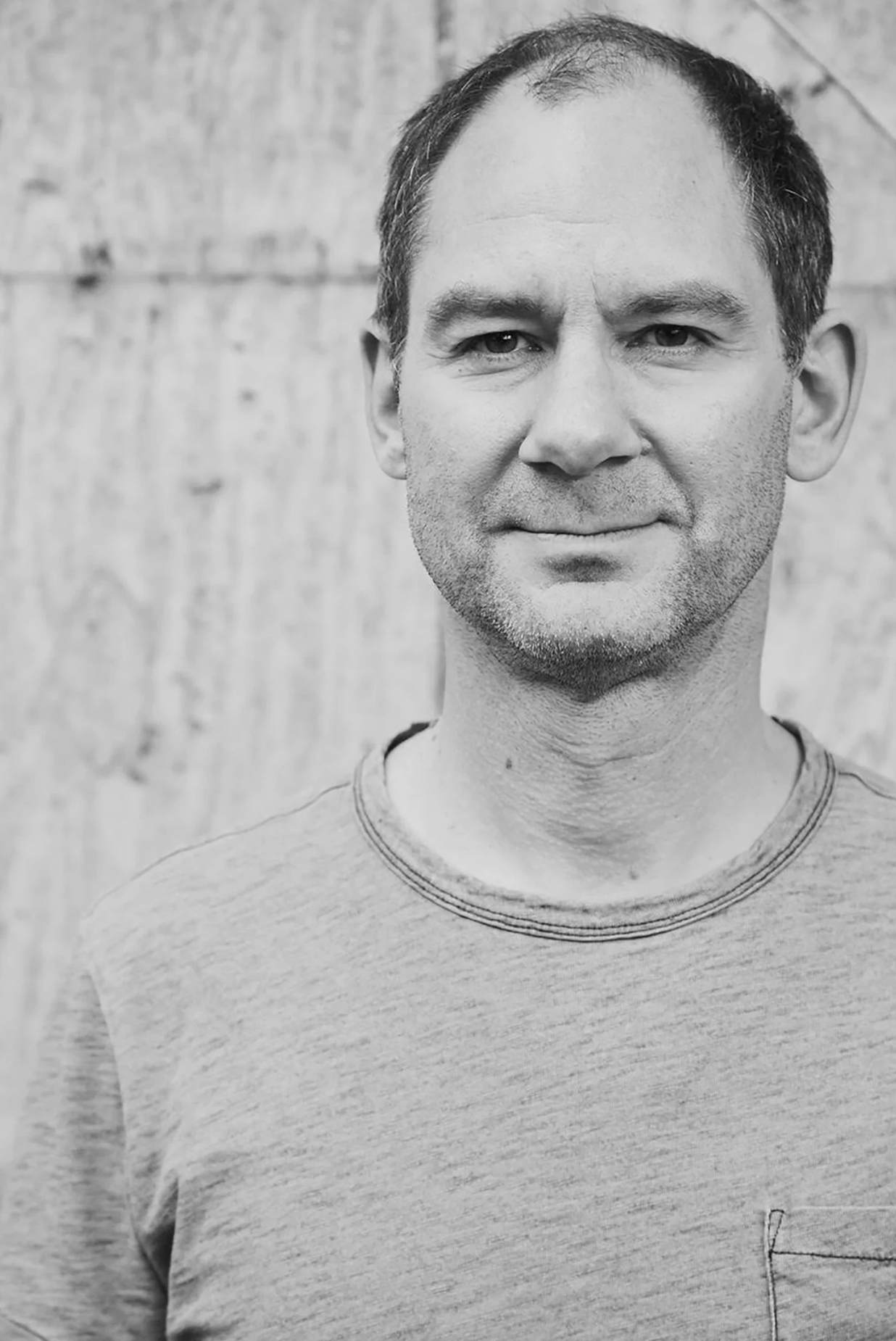
Courtesy of Jonn Herschend
Jonn Herschend is hesitant to call himself an honorary Pittsburgher. Sure, he’s never lived here, but he knows about and thoroughly enjoys the Pittsburgh Left, which makes him more of a Pittsburgher than I will ever be. Herschend has spent plenty of time in the city and is deeply enmeshed in its vibrant art scene. In 2015, he contributed to Carnegie Mellon professor Jon Rubin’s Last Billboard project and, more recently, collaborated with Lenka Clayton and Phillip Andrew Lewis, conceptual artists in Pittsburgh. The duo wrote for Herschend’s publication, The Quarterly Report, about their shared love for collecting tongs. From that piece, Herschend’s documentary, Lenka and Phillip Collect Tongs, was born.
As the film’s title might imply, Herschend likes things to be straightforward in a way that allows the audience to be a part of the art he’s creating. For a while, he got into making films with PowerPoint, or “the people’s software,” as he calls it. What excited him about filmmaking in this form was that it was a video that forced the viewer to imagine everything.
“I flew an airplane over San Francisco years ago that said, ‘I'm sorry.' A big banner. It flew over the city for a long time. My whole thing was like, it's a narrative open to anyone. Everyone can make a narrative like, oh my God, is that someone apologizing to their significant other? Or is it the city apologizing to us? Is it the pilot saying sorry?”
“I feel like the viewer is often left out of the equation. Of course they do all these market studies to find out what viewers like. I don't want to make something necessarily for the viewer, but I like the viewer as a collaborator.”
Herschend wouldn’t classify himself as a documentarian. He points to Nathan Fielder and Lance Oppenheim’s recent You Can See Everything as the balance he’s interested in finding when making art.
“We're all kind of fictional. I love the idea that we're fiction and truth. The idea of playing with what is reality, what is documentary, and what isn't will be huge going forward.”
This interest in the blurred lines of reality and fiction might be rooted in the fact that Herschend was raised in an amusement park in the Ozarks. He remembers his dad going to work there every single day while the park acted as Herschend’s babysitter. They’d dress him up in 1880s attire and let him loose. As he got older, he worked as a train robber or a conductor (depending on the day). Herschend thinks his experience working in the park would translate well to a script he hasn’t cracked yet. Anyone who has worked in a theme park knows it’s a strange blend of the usual job drama behind the scenes, but in front of guests, the employee is an integral part of selling a facade. To work in this environment is to understand the mundane can be magical, the magical mundane, and that somewhere in the middle is the sweet spot.
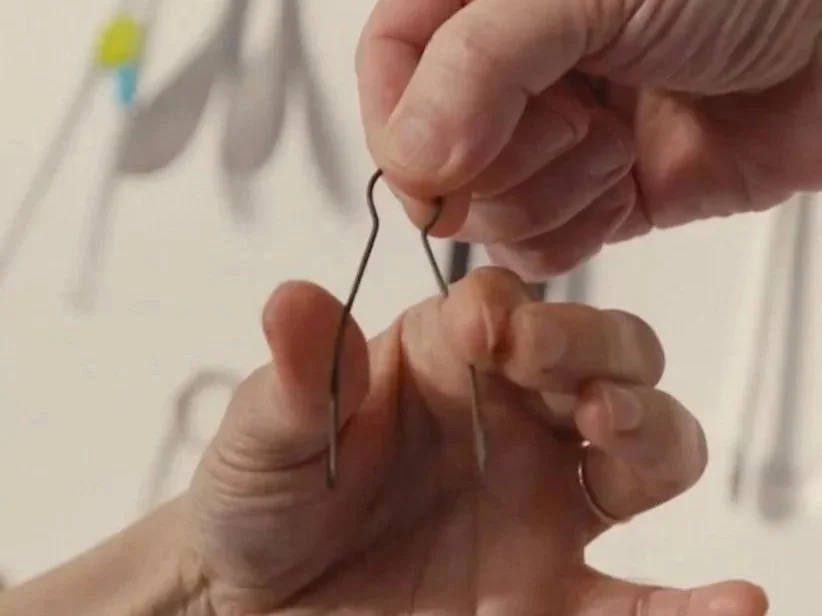
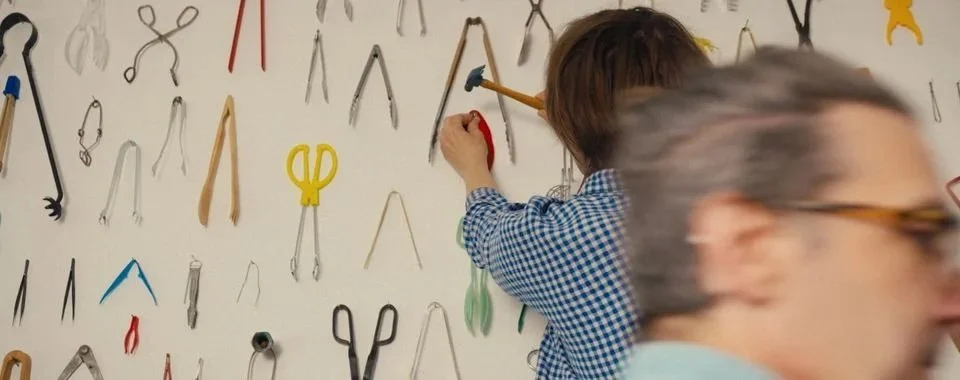
It’s no wonder Lenka and Phillip caught Herschend’s attention, because their collection of tongs exemplifies that middle ground. In Herschend’s documentary, the tongs are on full display. They hang on the walls of Lenka and Phillip’s studio and home in an orderly fashion, yet they're also extraordinary. You can walk into most big box stores and find a set of tongs, and it’s this lack of scarcity that excites the duo.
“I think their definition of a tong, and they will probably correct me on this, is anything you can tweeze together to pick something up. They have the musical ones too, though. Anything that squeezes together that’s useful. It's a broad definition.”
Courtesy of Lenka and Phillip Collect Tongs
“This sounds strange to say, but I figured out really late in life that I can make people feel comfortable in front of the camera. I give them the confidence that they can be themselves. I think an interviewer has to be curious by nature and leave room for the excitement of discovery. No matter how much you plan, what you think it's going to be, it's always better once you get the camera rolling. I think coming in without a plan is a bad idea.”
In the documentary, Phillip says that collecting tongs is “a madness I don’t feel in control of, but I'm happy to feed.” Herschend feels similarly in his artistic pursuit. Beyond film, he’s an interdisciplinary artist and experimental publisher whose work has been featured at the Whitney Museum of American Art, the San Francisco Museum of Modern Art, Pittsburgh’s own Mattress Factory, and more. Herschend sees the pursuit of art as equally important as the output.
“The most important thing in art is not understanding what you're doing and just kind of diving in. That’s what these projects are about for me. If you have a friend with a camera who's willing to come alongside you and someone to do sound, just go do it and see where it goes.”
“I think that's a little bit lost these days, because when I talk to younger filmmakers, it's like, well, I don't have the money to pull it all together. Don't worry about that. You have an iPhone, and honestly, they do a great job. If you come out of an art school, you’re supposed to have an idea of what you're doing before you do it, right? I just like that all you need is an inkling of something you're interested in to go after it.”
“Maybe it's a complete failure, which I have plenty of, and maybe it'll be something beautiful where you had no idea what was going to happen. You don't know unless you dive in. That's the madness part.”
The score to Lenka and Phillip Collect Tongs is as charmingly whimsical as you might imagine. Herschend has been working in collaboration with composer Silas Hite for too long to remember. As far as he knows, they’ve “always been working together.” They’ve worked on a theme song for Cleveland and another for a train station in Copenhagen. After those two out-of-left-field assignments, a score for a documentary is easy.
Courtesy of Lenka and Phillip Collect Tongs
“I don't know how to talk to composers when I'm doing work. I really don't. I've worked with several composers for different projects with our production company and I always feel like I'm saying the wrong thing. Silas is so easy to work with, and he gets what I'm talking about from the very beginning.”
“My only battle is now that we work so well together, I want to be careful that music isn't in everything. I do think it's more powerful sometimes to have silence and then bring that music in.”
With a subject like this one, of course some type of tong sound had to make its way into the score. Herschend and Hite talked about using tongs to play the keyboard as a sweet nod to Lenka and Phillip. Part of why Herschend enjoys collaborating with Hite is his fearlessness and willingness to explore a myriad of possibilities for what the score could be.
“Silas really gets into writing the score. It's not clinical. He really gets excited and dives in. The level of professionalism is out of control for such a casual person.”
Even by the end of our conversation, Herschend is still hesitant to take on the title of honorary Pittsburgher, but it’s hard to deny that he has roots in this town. His Mattress Factory show was back in 2009 and that’s when he says he “first fell in love with Pittsburgh.” Herschend was adamant that Lenka and Phillip Collect Tongs premiere in the city first before it played anywhere else. One of the attributes people use to describe a Pittsburgher is their humbleness, so perhaps his timidity around this identity justifies it more.
Follow me on BlueSky, Instagram, Letterboxd, TikTok, YouTube, & Facebook. Check out Movies with My Dad, a podcast recorded on the car ride home from the movies.
Support your local film critic!
~
Support your local film critic! ~
Beyond the Cinerama Dome is run by one perpetually tired film critic
and her anxious emotional support chihuahua named Frankie.
Your kind donation means Frankie doesn’t need to get a job…yet.