
Cinematographer Ashley Barron, ACS Blends Spielberg and Lynch in How to Get to Heaven from Belfast
This interview was originally posted on TV Obsessive.
What do you get when you mix the visual style of Twin Peaks and Steven Spielberg? The answer is Lisa McGee’s How to Get to Heaven from Belfast. Many may recognize McGee’s name from her beloved, chaotic sitcom, Derry Girls. That show and How to get to Heaven from Belfast share some comedic similarities, but her latest series is a murder mystery wrapped in the expected sharp-witted jokes. In order to start the visuals of the series on the right foot, McGee called upon cinematographer Ashley Barron, ACS. She spent some adolescent years in Ireland, so it was a special treat to be able to return for such a deeply Irish work of television.
“I grew up in the southwest of Ireland, which they called the South up in the North,” laughs Barron. “Shooting in Belfast, you’d feel that history. Even on set, you can feel the history amongst everyone. It’s in the vernacular, it’s in the jokes between crew. Some crew can actually speak Ulster Irish. That was very special.”
“One of the things that was important for the director was that we didn’t present Ireland in the storybook, postcard way you often see. One of the things that was a priority for us was to present it in a slightly different manner. Give it more color, more vibrance. I think the fact that the show and the crew were so deeply ingrained in that culture created a richness to what you see. It was like I was coming home.”
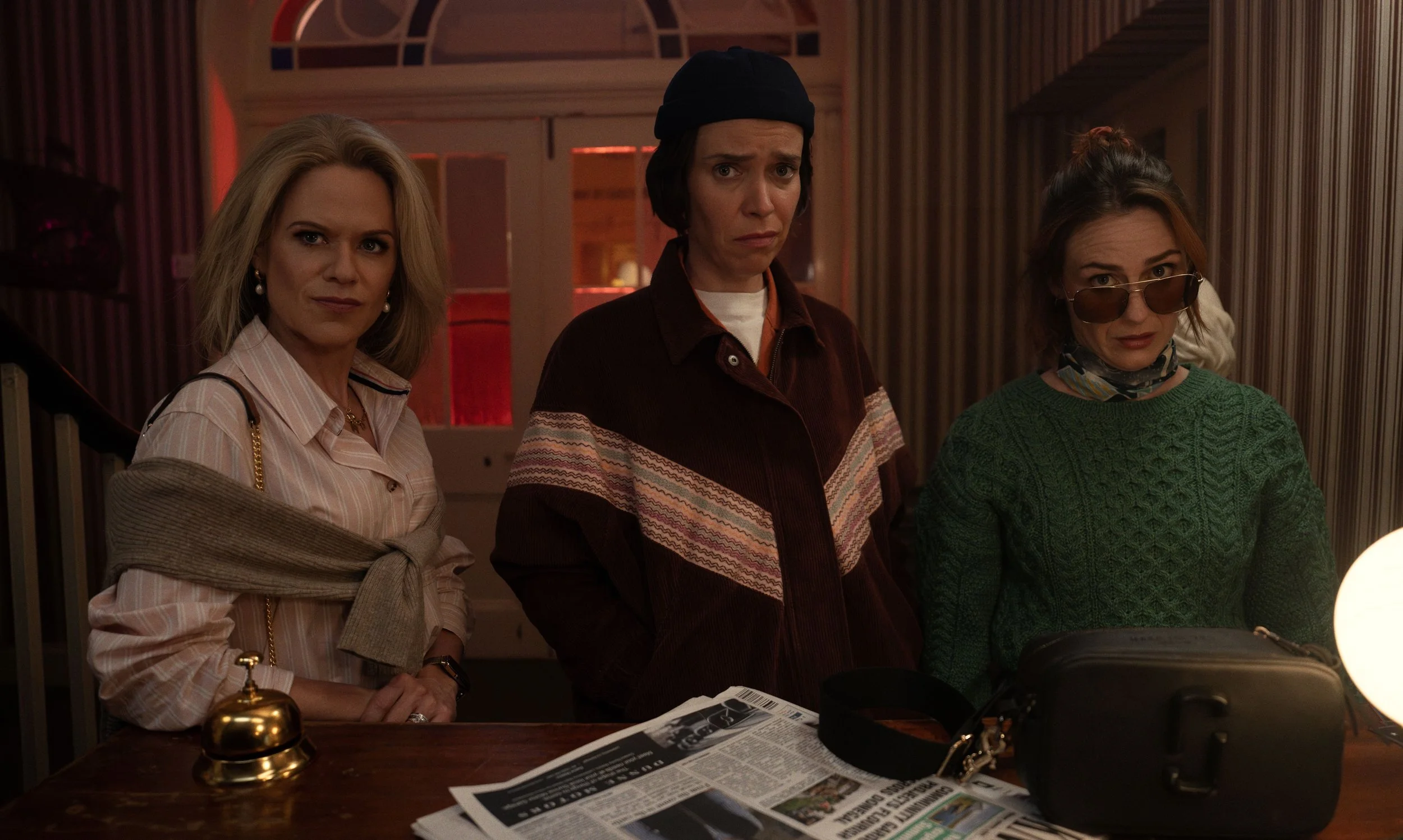
Cr. Christopher Barr/Netflix
Much like Barron, the three main characters of How to Get to Heaven from Belfast also find themselves coming home in a way. Dara (Caoilfhionn Dunne), Robyn (Sinéad Keenan), and Saoirse (Roisin Gallagher) are three tight-knit best friends who have known each other since their school days. They’re thrown for a loop when they receive an email imploring them to return home for the funeral of Greta (Natasha O’Keeffe), with whom they were once close. They haven’t spoken to her in decades, but decide to return anyway to mourn the loss of their one-time friend. At the funeral, though, circumstances surrounding Greta’s death aren’t adding up, so the friends decide to solve the mystery on their own.
While the combination of Twin Peaks and Spielberg may seem at odds, the team behind How to Get to Heaven from Belfast sees it as the perfect blend of what McGee wrote in her script. These two touchpoints provide a glimpse into the dark, playful nature of the series.
“One of the phrases that was used about our show was ‘beautifully creepy.’ I think we take it a little bit more towards creepy than perhaps Spielberg and E.T. did, but there is that childlike wonder mixed with the supernatural themes. The opening sequence, for me, probably represents it best. It’s heightened, it’s enigmatic. I remember being in the ’90s as a kid and seeing Twin Peaks, and even then I was like, this feels strange. That’s what we kind of want people to come out feeling with How to Get to Heaven. On set, we even would sometimes turn to each other and say, I think it’s just a bit too weird.”
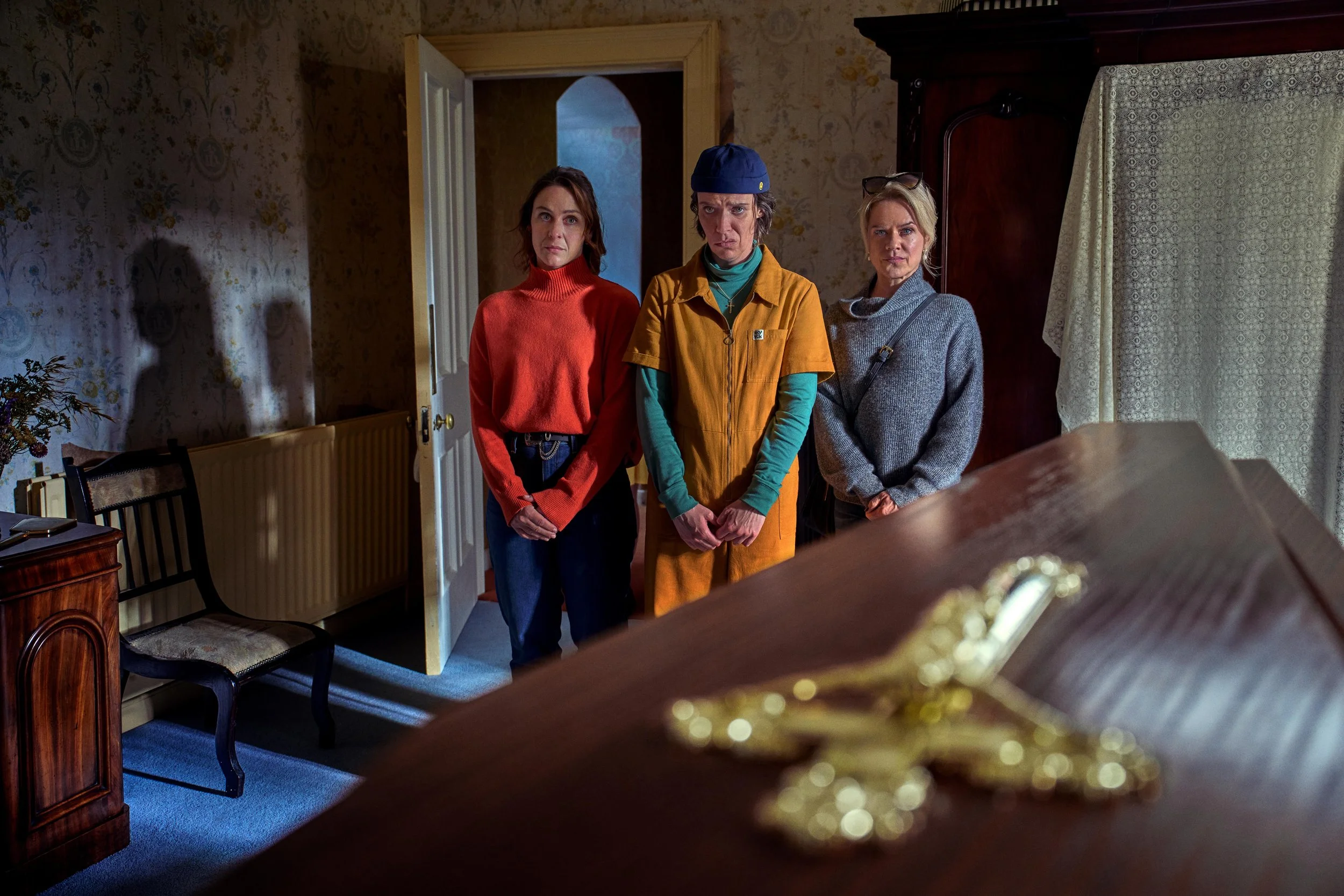
Cr. Christopher Barr/Netflix
“We felt we were on the right track because the show had almost a surreality to the comedy and the setting. That interplay between surreality and comedy is what makes the series shine. We scouted locations, and we loved the hotel we found because of the weird wallpaper. Things like that where you’re like, this is weird, what is this? We wanted to find where Lisa McGee comes into the Twin Peaks world.”
The trick of getting the visual language of How to Get to Heaven from Belfast to work was to understand how a comedy and a murder mystery could coexist. Murder mysteries rely on dark, looming shadows while comedies live in the broad daylight. One might think that a cinematographer would have to adjust their shooting plans to accommodate both genres, but what excited Barron about the series was that it gave her the chance to use each genre to enhance the other.
“It’s a comedy that wants the cinematography to be tonal. I tried to bring the darkness where I could and play into what each scene, location, or character needed to feel. How they felt within the environments or with each other. We actually didn’t have to change too much so they could live within that world. It was the interplay of it that made it so magic.”
Barron prides herself on being a cinematographer who is focused on ensuring that her work makes the performers more comfortable and confident. More than framing a good shot with good lighting, Barron wants the actors to have the freedom to play in a way that opens up the possibility of what their performance could be.
“The performances are what carry the show, especially in the case of How to Get to Heaven from Belfast. It’s the comedy and Lisa McGee’s words that carry it. The more comfortable they are, the better the performance they give.”
“Oftentimes, that tends to translate to creating a set where they can move freely, and they can embody their character within the space. I always want to have creative flexibility. That means lighting in a 360 approach and figuring out how to do it in a way that doesn’t impede physically. No stands or marks they could hit.”
“Even if it’s multicam, like we had on the show, having that gives an energy to the actors and their performances. They’re what connects the audience to the material. For me, it’s paramount to create a way you can maintain the visual tone, the aesthetic plans, but do it in a way that they can take it home.”
Barron served as director of photography for the series’ first three episodes. In the second episode, “The Secret,” the show introduces us to Robyn, Dara, Saoirse, and Greta as teenagers. Before their friendship fractured, before Greta died, and the source of whatever secret hangs heavy over their heads in the present day.
“A lot of the look of those scenes came from our colorist. He wanted it to feel like, not exactly a Polaroid, but he wanted it to look like it was of an era. We had references that had this faded element to them. It’’s not quite like an old photo that you have, like a vintage classic photo, but it was that feeling of the ’90s and photos that faded over time.”
“We played with different levels of film grain. I think that really, really underlined the feeling we were going for. You get to choose how much grain to use per scene, but also in different parts of the frame. You can have more of the grain in the highlights versus less of the in the shadows and such.”
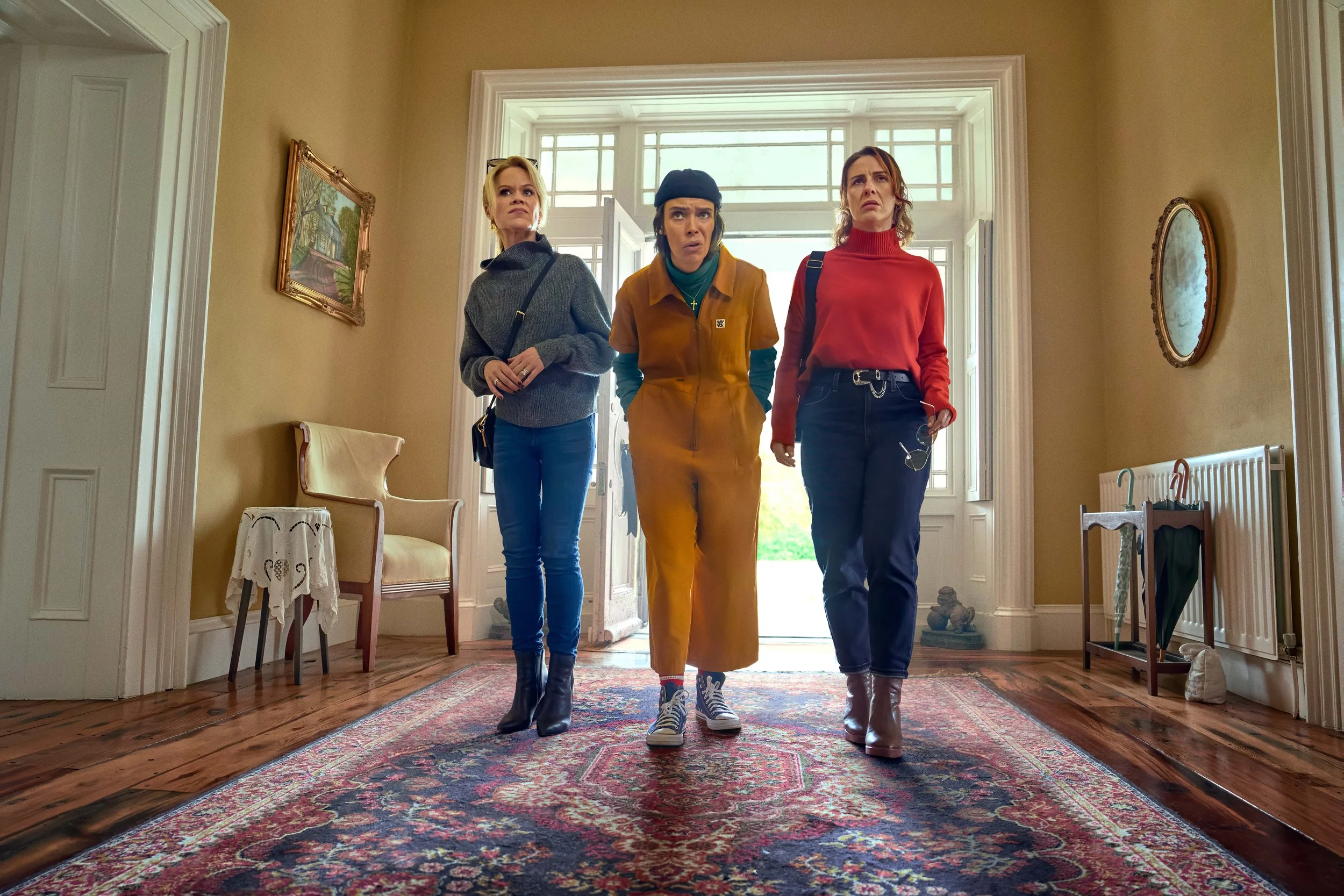
Cr. Christopher Barr/Netflix
If you start watching How to Get to Heaven from Belfast and find yourself taken by what appears to be a fisheye lens, you wouldn’t be the first to bring it up to Barron.
“You’re the second person to ask me about the fisheye,” laughs Barron.
She goes on to explain that what appears to be a fisheye lens is actually a 21mm lens that gives a wide, anamorphic perspective. It’s a trick they pulled out when they needed to expand the scope of vision.
“We chose to shoot with the Atlas Orion Anamorphic. They’re beautiful because you can lean into their anamorphic nature or you don’t have to. We wanted to be able to have that flexibility. We picked it first because we liked the texture of the lens and that it allowed us to frame all of our three characters in one and technically see them all in focus, but then we realized it created this warp or bending, depending on how far away we were from the subject.”
“It allowed us to choose the moments to deploy this effect. I don’t want to give too much away because I think it’s a really good moment when we first use it. You really feel it. I haven’t been privy to someone seeing it for the first time where they didn’t crack up during that moment.”

Follow me on BlueSky, Instagram, Letterboxd, TikTok, YouTube, & Facebook. Check out Movies with My Dad, a podcast recorded on the car ride home from the movies and I Think You’ll Hate This, a podcast hosted by two friends who rarely agree.
Support Your Local Film Critic!
~
Support Your Local Film Critic! ~
Beyond the Cinerama Dome is run by one perpetually tired film critic
and her anxious emotional support chihuahua named Frankie.
Your kind donation means Frankie doesn’t need to get a job…yet.