
Meet the People Behind the Resurgence of Filmmaker-Focused Distribution: Billy Ray Brewton and Ryan Verrill of Antenna Releasing
There was a time when physical media ruled. CDs, DVDs, cassettes, and Blu-Rays all allowed fans to bring home the music and movies that meant something to them. As technology changes and people are able to digitally purchase TV shows, films, music, and more, larger companies have started to shy away from releasing their catalogs in a tangible format. Best Buy no longer sells DVDs or Blu-Rays in stores, while Target and Walmart have substantially cut back. What many people don’t realize is that these digital purchases can be withdrawn at any moment when the license agreement runs out. In this desert of tangible media, enter Antenna Releasing.
Cofounded by Ryan Verrill, Francis Galluppi, and Billy Ray Brewton, Antenna Releasing is a filmmaker-focused distribution company. To Antenna Releasing, distribution means that both theatrical and physical media are done in a way that’s thoughtful and respects the effort of those who made the film.
There are perhaps few people as qualified as Verrill to take on the role of Director of Physical Media. Verrill runs The Disc-Connected YouTube channel, Someone’s Favorite Productions podcast network and production company, and “The Physical Media Advocate” magazine. So much of Verrill’s work is in the preservation of films, both older and contemporary, and the role of physical media in this conservation effort.
But how does one go from physical media lover to co-founder of a boutique distribution company?

courtesy of Ryan Verrill
“I’ve been The Disc-Connected for the last five or seven years,” recalls Verrill. “Along the way, I started doing some interviews. One of them was a young guy named Francis Galluppi, who had just put out The Last Stop in Yuma County. We started talking about physical media and the whole tone of the conversation changed. That was hilarious, because talking about his movie, he was like, yeah, it’s a good movie, it’s fun, all that. But we started talking about physical media and his eyes lit up.”
“We’re suddenly geeking out about audio commentaries from discs that we heard when we were fifteen or something like that. He was immediately a different person. While we were discussing things that we wished could happen on some of these discs, he jokingly said, well, should we start a Blu-ray company? I was like, oh, that’d be fun. And now it’s real,” remembers Verrill.
“A few months later, I showed up at his house, pitched a couple things, and he fell in love with the idea. I started building the skeleton of what we would do and realized that with my Rolodex and Francis’ connections, it would be great if we could turn this into a real, full-scale thing from day one. Billy Ray was the perfect person to bring on as the counterpoint to us,” explains Verrill. “It was possible because I built up the knowledge and the relationships from producing discs for years behind the scenes and helping with supplemental features, meeting people, and essentially doing almost every step of the process, other than putting my name on the company. I said, well, why don’t I just do it instead of doing it for everybody else? So here we are.”
Brewton’s career spans more than twenty years in the programming field. He’s also been in the director’s chair for films and stage productions, and served as producer for a variety of films. His most recent movie is Coroner to the Stars, which will begin its theatrical release after a decorated festival run. Like Verrill, the dream of building a company like Antenna is something that’s always been in the back of his mind.
“I would say, for me, the most difficult part was trying to wrap my head around why it took me so long to do something like this,” says Brewton. “It’s something I’ve thought about for a very long time. The most difficult thing for me to wrap my head around is just why it took me so long to bet on myself.”
“I think the most gratifying part has been the reception we’ve received since we’ve launched,” recounts Brewton. “It has kind of validated, at least for me, all the reasons I wanted to do something like this. The way this has been validated since we started it, by filmmakers, by everybody we’ve talked to, has been so rewarding. We’re on a pretty good streak right now of getting good news almost every day. We’re trying to keep that streak going. I know it has to stop at some point, but we’ll keep it going as long as we can.”
“On my end, I think one of the biggest things is trying to show restraint,” adds Verrill. “Billy Ray and I both love an insane amount of films, and we really want to give everybody their own fair shake. It sounds ridiculous, but saying no right now is difficult because we know there are certain things we just couldn’t give our full attention and mission to if we’d said yes to everybody we’d really like to.”
“There’ve been some things we’ve had to pass on that we really think we could have given some great love and attention to, but it would take away from our current goals with some of the other films,” continues Verrill.
“When you build up all the skills and relationships that one needs to do one of these things, it’s amazing how, when you act with integrity, people continue to say yes to you. If you just respond respectfully and do the right thing by people, it turns out that’s a good way to grease the wheels to get something done,” adds Verrill. “Honestly, a lot of it has been fairly simple. I kind of assumed, naively, that being in the middle of the country would make this much more difficult. It helps that one of my partners is in Los Angeles, and being able to do so much remotely has made it so that location isn’t really a barrier.”
Brewton is Director of Acquisition for Antenna Releasing, and while the role is similar to his years of experience as a festival programmer, this new endeavor also allows him to have a little more freedom in his decisions.

courtesy of Billy Ray Brewton
“I’m still treating programming and curating the same way I always have. When I’m building out a film festival schedule, or even if I’m just programming a movie marathon for my friends, I’m treating it like a mixtape,” explains Brewton. “I’m trying to create a vibe, but also create a throughline that, even if it’s not obvious, people will catch if they’re really paying attention.”
“What has changed is that when you’re programming a film festival, sometimes you’re kind of constrained by your festival’s parameters,” Brewton says. “There are so many factors, like where you’re located, what’s the audience space, etc. You’re always constrained to some degree, but the restraints are off now. We’re not trying to pigeonhole ourselves into one kind of film that we champion. We’ve got documentaries, we’ve got narrative features, we’ve got genre films, we’ve got weird, wild, out-there stuff. That said, would we be interested in a historical drama if it came our way, if it’s the right fit? Absolutely.”
“The big difference is that it’s allowed me to widen my expanse in terms of what I’m looking for and what I can have fun with,” says Brewton. “Like Ryan said, it’s hard because we’ve just launched. We’re getting a lot of people sending us films. We’re looking at a lot of stuff. It’s hard to say no, but one of the big tenets of what we’re doing is trying not to over-program so we can actually focus on the titles in a thoughtful way instead of being inundated with having five or six titles a month.I think a lot of predatory distributors do that.”
In terms of what makes a film right for Antenna Releasing, Brewton and Verrill have faith in their own taste. Beyond that, though, in the back of their minds, they’re also thinking about the fact that so many movies are being lost every single day.
“There are so many films that are either on the verge of being lost, have the potential to be lost, or are put in a situation where other people aren’t willing to take a risk,” explains Verrill. “The reality of even the home video market, we can easily talk about how many films haven’t been released on anything past VHS. There are thousands and thousands and thousands of films that you can’t see in high-definition on streaming. There’s very little discussion about how many of these films are contemporary films that will play a festival beyond YouTube or Hulu for a few months, and then the license runs out and there’s nowhere else to see them. They’re gone forever.
“At that point, is it technically lost media? There are a few people in the world who have a copy on their hard drive, sure, but the average person can’t find those films,” continues Verrill. “It’s not something that’s easily accessible. It’s not media that is readily available. For many of those people, it’s their life’s work. Our real heart here is to try to get some of those out in front of people and rescue them in a way that makes sense.”
“Not to be cliché or silly about it, but that old adage of the guy walking on the beach and picking up silver dollars and throwing them back in the ocean and saying, well, it matters to that one. That’s the same with film,” says Verrill. “All we can do is hope to save one film at a time. There’s a huge danger right now for things that were captured on film that we’re losing to deterioration, vinegar syndrome, and film just literally obliterating before our eyes. Archive fires are a real thing. The hard part is that proper archiving shows we don’t even know exactly what films are gone. The approach really is just to do what we can as soon as we can. The more people who approach physical media with an open mind the better. Not just buying their favorite genre franchises because, oh, man, the new shiny Halloween got released. If you take a risk on some of these more obscure films, that will provide income and the ability for some of these places that aren’t getting that sort of support to survive, and money kind of makes the world go round. The only way we can speak is with our wallets.”
One of the core tenets of Antenna Releasing is ensuring that the decisions the company makes are the right ones for the individual films and the people who made them. One size does not fit all when it comes to movies, and both Brewton and Verrill are acutely aware of that, but it manifests in different ways, given their different roles.

courtesy of Antenna Releasing
“For me, filmmaker-focused means a lot of things. I think it’s pretty simple at the very base of it. Just thinking about the filmmakers with every decision you make. I know that seems like it’s the bare minimum, but it’s shocking how many distributors don’t do that,” offers Brewton. “Most distributors, they go into a situation and they’re like, we have all the answers, we know what we’re doing, you sit there and just wait for us to decide we want to send you the reports of how your film is doing. That does nothing but create an antagonistic relationship between a filmmaker and a distributor.”
“Our filmmakers sign off on everything we do with their film. Whether it’s their artwork, partners we’re working with, etc., we want to make sure the filmmakers have buy-in,” explains Brewton. “It’s really simple on that level, but it also goes beyond that. We certainly offer pretty generous revenue splits to our filmmakers. We invest in things that we know filmmakers are passionate about, which are theatrical and physical media. We know those are the things that get filmmakers excited, so that’s what we want to specialize in and give them those avenues they wouldn’t have otherwise. It’s really just about being transparent, honest, and making sure there’s a trust, that we’re not violating that trust, that they don’t feel like they’re trapped or being forced to do something they don’t want to do. It really is just as simple as being thoughtful and decent.”
“The biggest thing, especially with home video releases, is that a lot of these places license films and the connection is gone almost immediately, unless they want the director for an audio commentary,” explains Verrill. “I’m even approaching these things for some of our upcoming releases to ask them, what are your favorite home video releases? What are the things you’ve loved on physical media that you would love to see in your film? How can we try to recreate those? We’ve discussed everything from drunk commentaries from the filmmakers to an ’80s-style making of a featurette to very specific artwork they’d want to use on the back side of the sleeve.”
“Just asking their opinion, you can tell so much because they don’t ever get that opportunity,” emphasizes Verrill. “It’s nice to see them responding in a way that shows they’re invested as much as we are, which is hilarious, because it’s their film. Of course they’re invested.”
We’re in the midst of what could be a record buy-out of Warner Bros. by Netflix. What began as a mail-in DVD service has fully pivoted to a streaming service. While Netflix has had some limited theatrical runs for their Oscar-hopeful films, the focus has remained on the streaming side of the industry. Few of their original films and TV shows are available to own, and the potential acquisition of Warner Bros. begs the question of what that will mean for new releases from Warner Bros. Despite this looming acquisition and the industry at large shying away from physical and theatrical releases, Brewton and Verrill have never felt more confident.
“I think people have maybe misread Netflix when it comes to theatrical. Let me be clear, I’m not here defending Netflix by any stretch,” says Brewton. “I’ve started to have a change of mind on them because I don’t think they were against theatrical releases. I think it’s very much that they just didn’t have the infrastructure to do theatrical the way Warner Bros or Paramount or Fox are doing. The amount of money it would have taken to build that network would have been a lot. I think even one of the Netflix reps said recently that it just wasn’t one of their top priorities. If they get Warner Bros, they have that infrastructure, they have that network.”
“I don’t know that we’ll even see them reduce the theatrical window. I don’t know, they might. It wouldn’t shock me if they did, but they’re not going to abandon the theatrical model. Especially when you look at stuff like K-pop Demon Hunters and how well that did for them theatrically,” explains Brewton. “I think now that they’ve got the infrastructure, you’re going to see them embrace theatrical in a way people probably didn’t expect they would do.”
“Now the bad news is that they’re going to end up being a monopoly at some point across the board on all the stuff. That’s bad news. I certainly would rather not see them merge with Warner Bros. I’ll just be clear about that. I don’t think that’s smart,” Brewton states emphatically. “I’m hoping there are some people in Congress who will keep that from happening.”
“ I feel confident betting on physical and theatrical because I’ve never thought the theatrical experience was dead,” says Brewton. “I don’t think the experience itself is dying. I think the audience is just getting bored and frustrated. I think they’re getting bored seeing the same types of films over and over in theaters. I think they’re getting frustrated in that they’ll go to their local theater and the sound doesn’t work right. Or the bulb isn’t bright enough and they have to wait in line 45 minutes for popcorn. If you come to them with something different, a little more thoughtful, and a little more curated, I’m interested to see what that looks like as a model going forward.”
“I see the theatrical model almost regressing in a good way to sort of what it was,” Brewton goes on. “We jokingly call it the John Waters model, which is a more regional style of releasing, more thoughtful releasing. Not just putting it in theaters without any rhyme or reason.”
courtesy of Antenna Releasing
“For physical media, I don’t even really feel the need to defend it because I can hold it,” says Verrill. “I can show you a disc that I bought 23 years ago. Who else can say that about a digital file? Who else can say that about anything? My disc I bought used for $3 in 2003 I can still watch with my kids. There’s nothing to defend there. It’s clearly superior. Not to mention the quality is way better than streaming. We could get into the nuances of that, but everything about it is so much better, much more reliable, and meaningful. Even the ritual of it, of pulling something off your shelf, smelling the plastic as you open it up, sliding the disc in, and getting to choose off a menu without being inundated with 800 other choices, or the credits being interrupted to say watch our new documentary. That sucks. I mean, there are so many things that make streaming an awful experience. We really just want to hit it head-on and say, listen, we can do better.”
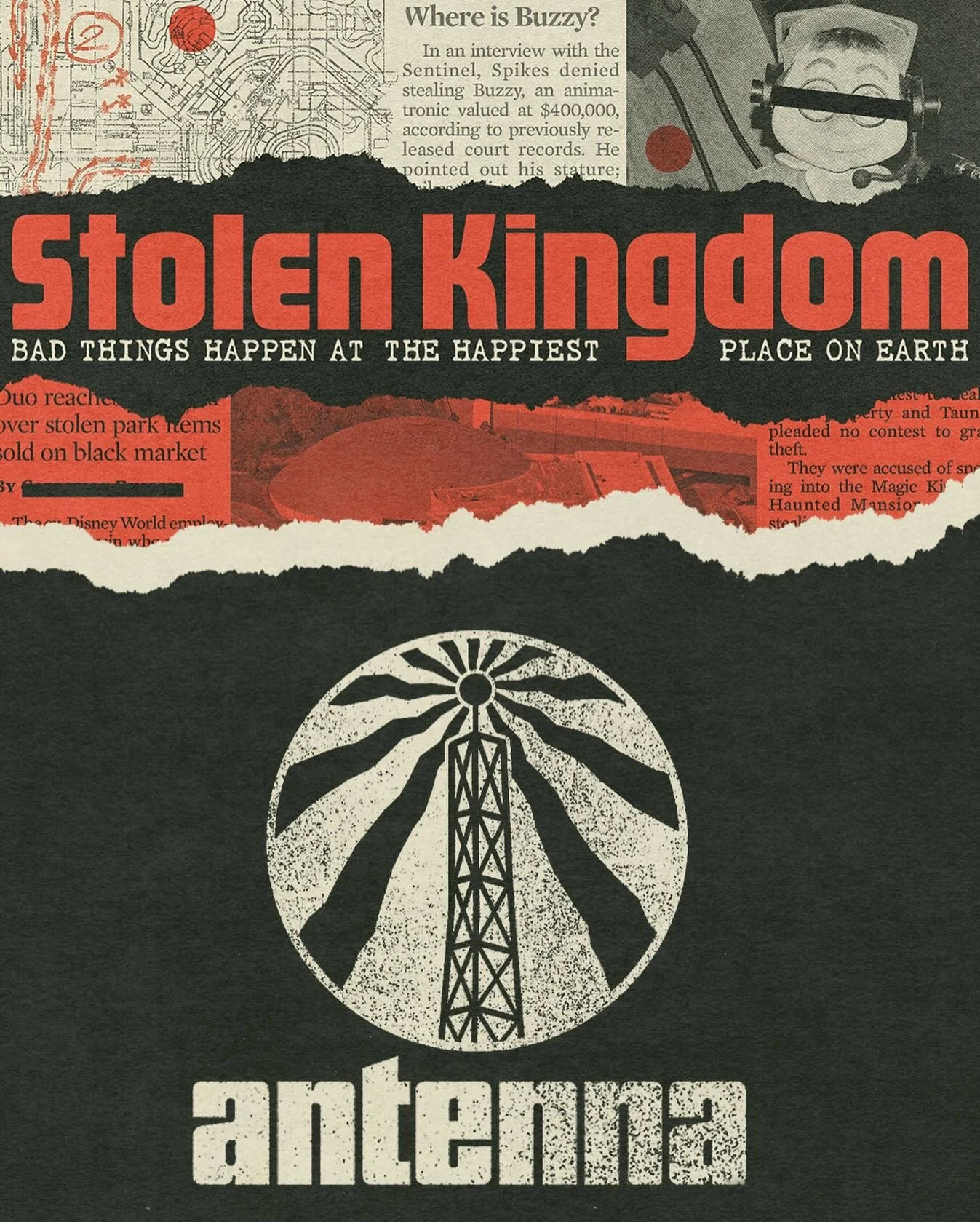
Antenna Releasing’s first release will be Joshua Bailey’s Stolen Kingdom documentary. It’s a madcap, truth-is-stranger-than-fiction doc about the Happiest Place on Earth’s seedy underbelly. After Brewton caught the flick at the 2025 Slamdance Film Festival, he knew it would have a place in Antenna’s mission.
“I saw the film with a packed audience at Slamdance, and it was such a crowd pleaser in a way you just don’t get with documentaries very often,” recalls Brewton. “I remember sitting there thinking, wow, this film is going to get picked up in a snap. Flash forward months and months later, and it has not been picked up. They’d gotten really awful offers from some distributors. When we were deciding if we were going to finally pull the trigger and make this thing a reality, it was really like, oh, I need to see where Stolen Kingdom’s at.”
“We met with them and they liked what we had to say. We liked their ethos. We’re both very DIY in the way we’re doing things. It just kind of fits. To me, it became a no-brainer,” says Brewton.
“I grew up in Southern California and I went to Disneyland many times throughout the years. Funny enough, over my desk right now, I’m looking up and there’s a picture of me and my wife at Disneyland ourselves in 2012, I think it was,” smiles Verrill. “ I wouldn’t call myself a Disney adult. The lore has always been exciting, and as a movie fan it’s kind of hard to ignore the power of Disney overall, you know?”
As people passionate about physical media, it feels only right to ask Brewton and Verrill about their favorite examples of special features. To Verrill though, it’s “like picking a favorite child.” For Brewton, the answer comes more quickly.
“I tend to enjoy badly made making-of documentaries that feel like they’re shoved on there at the last minute. Yeah, I really dig those,” laughs Brewton. “I think people would be surprised at how many times I’ll bring those up on YouTube and just have them playing while I’m doing stuff around my house. I really dig those. Especially when it’s this really ramshackle thing that’s 30 minutes too long. I love those.”
“A friend I worked with on a project called Someone’s Favorite Productions, we made a…it’s not a documentary, but essentially, there’s a filmmaker named Jim Wynorski who has made some of the the simply worst and best movies of all time at the same time,” explains Verrill. “There’s a movie called Popatopolis that’s a documentary about the making of one of Jim’s films.”
“Through my little side work, Will Dodson, he made a new character that’s ridiculous. We essentially made a short documentary showing the value and worth of appreciating Jim Wynorski that’s made tongue-in-cheek. My buddy wore a wig on this just to come across as hilarious,” laughs Verrill. “It’s all done in the style of Jim Wynorski. The cameras are shaky, there are a lot of really bad jokes, we used stock footage, and then the credits, there’s nudity in the credits. By the end, you’re like, what are we even watching? It’s hilarious and something I’ve watched way too many times, but it is a blast. Anybody who loves Jim Wynorski should go pick up the Terror Vision release of Popatopolis, because it is amazing.”
For more information about Antenna Releasing and the upcoming release of Stolen Kingdom, check out their website.
Support Your Local Film Critic!
~
Support Your Local Film Critic! ~
Beyond the Cinerama Dome is run by one perpetually tired film critic
and her anxious emotional support chihuahua named Frankie.
Your kind donation means Frankie doesn’t need to get a job…yet.