
Jessica Rose Weiss Talks Honoring Queer Stories in “Girls Like Girls”
Hayley Kiyoko’s directorial feature debut, Girls Like Girls, is eleven years in the making. In 2015, she released the single, “Girls Like Girls,” and co-directed its accompanying music video. The song and video went viral and led to Kiyoko becoming an important voice for the LGBT community around the world. Seven years later, Kiyoko released a young adult novel with the same name as the viral song. Finally, four years after that, Kiyoko’s deeply personal story will make it to the silver screen. While Kiyoko is a musician herself, she tapped composer Jessica Rose Weiss to write the score for Girls Like Girls, a task Weiss did not take lightly.
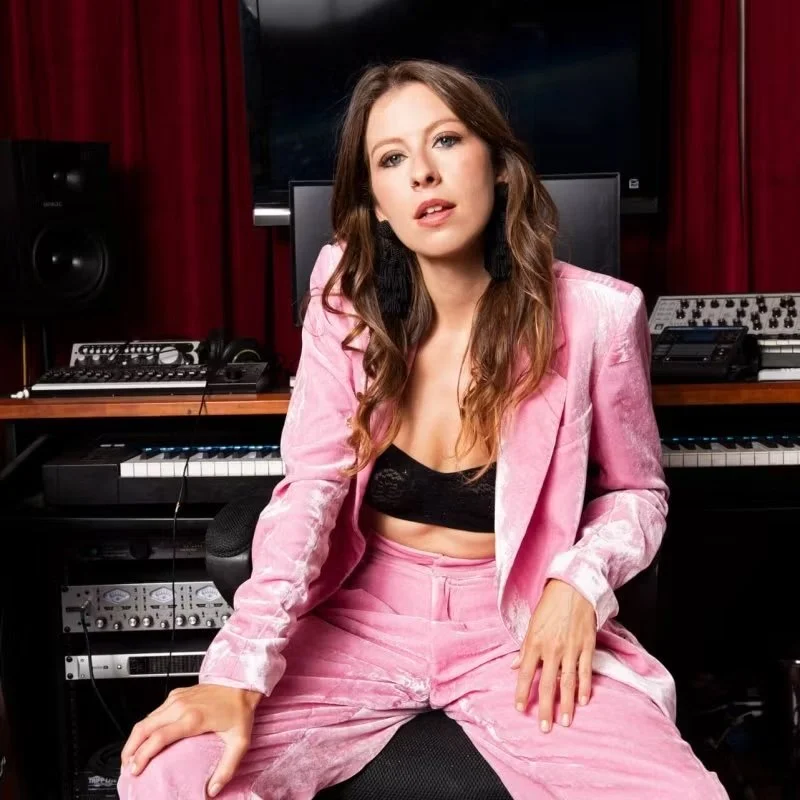
Courtesy of Lindsey Byrnes
Your love of music began with theater and ballet, and it’s something you’re still very involved in. This is the first time I’ve seen someone come to composing from that world. How did you make the transition, and do you feel there’s something that has uniquely helped you that wouldn’t have come if you’d gone the more traditional route?
Jessica Rose Weiss: That’s a great question. I did a lot of theater and dance growing up, and I went to a performing arts high school. Within the school itself, there were a ton of dancers and a lot of musicians who went to pre-college Juilliard. I was immersed in a very creative environment. We had no sports teams; it was just the arts.
I’ve been involved in the arts since I was born, basically. Music was a big thing growing up in my household. My mom plays piano. She was always playing music. The score from Out of Africa was on repeat all the time in my house. My dad’s very creative. He’s really wonderful at fine art, and he has a major love of classical music.
By the time I got to college, I was still doing theater, but I was planning to minor in photography. I think by sophomore year of college, I knew that music was where I wanted to go. I just didn’t feel the need to be on stage anymore. I wanted to be behind the scenes, not in front.
Originally, I thought, okay, well, I’ll be a songwriter and producer, you know? I want to be like Sylvia Massy or T Bone Burnett or someone like that. Then, you know, as life works itself out, the first job I got after school was assisting a film composer in New York City. Once I dipped my toe in and saw the process of writing music for film, I was just like, this is it. I found my calling.
Definitely not the traditional route, so to speak. Theater and dance, it’s all about story. Diving into a different world and trying to express the emotions. It happened pretty naturally for me. I took to it like a fish to water.
What was it about the Out of Africa soundtrack that your mom loved so much?
Gosh, I mean, to me, it’s the soundtrack of my life. I think it’s because John Barry is such a brilliant thematic writer. I think my mom just gravitated toward that. She’s British, so I think there’s a love of James Bond.
Out of Africa…that score is so romantic. It’s a masterpiece. An underrated masterpiece perhaps.
With Girls like Girls, I saw that you joined during the editing process, which is sometimes rare for composers. Was it the first time you experienced that? Does joining at that point in the production change your process at all?
I always make this joke. I call myself the clean-up composer. Maybe I’m giving myself an unattractive title, but this is another case where I’ve come in after the first hired composer wasn’t working out. I’ve done that several times now.
I think it was really useful for me to come in at the time I did because I could see the inner workings of what was going on. What wasn’t working and why it wasn’t working. The push and pull of figuring out what was missing and how I could lean in to help support the filmmaking process.
The earlier you can get on the better, because time is never our friend in this job. The more time I can spend under the hood and with a director, especially Hayley, understanding what the vision is, the better.
I think this might be, at least in my memory, the first time a song/music video has been adapted to a book and then adapted to a movie. It’s all Haley’s vision, and she’s obviously someone who has more of a music vocabulary than a lot of other directors. What was it like to work with someone who knows this project better than anyone ever will and can verbalize what she needs?
It was probably the best collaboration I’ve ever had. It could have gone the other way, right? Because sometimes, if you’re a musician, you walk in and you have a very clear vision in mind. I would imagine there’s sometimes the thought of, well, I could do this, you know?
Haley had a very clear idea of what she was going for and what she wanted, but she gave me the space and she trusted me enough to step back and let me dive in. Let me build a sound palette in a world and score some scenes.
Then she would come into the studio, which was amazing, and we would watch the scenes. We’d talk about what was working and what wasn’t working. Because she can speak the musical language, it was more fun and collaborative. She’d say, hey, can you mute that percussion, let’s hear it without that. I’m like, that’s the easiest revision I’ve ever had to do.
With directors who don’t speak the musical language, my job is to translate what they’re saying into music. This just made the process that much easier. My job was to support her story.
Speaking of Hayley’s idea for the score, you also did a new orchestration for the song that started all of this. That feels more personal than the score itself. What was it like to turn a pop song into a beautiful orchestration?
That was very late in the game. We’d discussed it earlier on. There was back and forth about what they wanted to do. At the last minute it was, hey, what do you think? I said, yeah, how much time do I have?
That was a level of pressure where I really had to step up and make sure I was honoring her work and her song. My very close friend Scott Effman, who’s a great producer, and I got together. I think I had laid out some kind of structure. Then we went in and arranged and orchestrated the strings. At the final hour, I turned to Hayley and said, do you think we could record this live? She told me there was no money left, but I said, can we find some money?
Hayley’s the best. She fronted the money for the recording. Boy, was it worth it though, because it took it to the next level. Also, one of the producers, Katie McNicol, was very supportive of it as well. It was surreal, you know? Hayley was very emotional about it, as anyone would be. I was so thrilled that she felt like she was being represented properly and that I’d done what she needed.
I rewatched the music video last night and then I listened to the new version. It feels elevated, but it has the same heart. From the score to the new songs and updated orchestration, you’ve really captured the sweeping teenage emotions. Your life is a movie, you feel like everything’s cinematic. You feel like these are the emotions that are going to rule your life.
For people who aren’t composers, who don’t understand that side of things, how do you create a score that makes you feel cinematic? That creates such a nostalgic feeling?
That’s a beautiful question. I think it always starts with the story, so I spent a lot of time watching the film, oftentimes without music. Trying to get into the soul of the film and the depth of the characters.
I realized very early on that the performances are so beautiful in this film. They’re very moving. Maya da Costa, who plays Coley, and Myra Molloy, who plays Sonya, are amazing. I realized that, in order to elevate the film using music, it had to, as you said, have an ethereal quality. There had to be something youthful to it. The story’s in the glow of your adolescence.
On the technical side of things, I felt like there had to be a lot of organic instrumentation to ground and support these characters. A lot of piano, acoustic guitar, strings, which I love using and writing for. Then some bespoke synths that I built using Hayley’s voice. She came in and she sang “oohs” and “aahs.” I used that as part of the fabric of the score. In some cues you hear her doing them a little, and then at other times you can’t recognize it as a voice because I’ve manipulated it.
I wanted her DNA in the score. Inserting her voice in there as a magical feeling, you know?
We’ve touched on it a couple of times now, but you’re joining something that’s part of a huge cultural touchpoint that dates back a decade. What does it feel like to come in at the 11th hour as a clean-up composer?
First and foremost, it’s an honor. I feel very grateful. I knew that venturing into this would be important on so many different levels. Not just for Hayley, but for that community. I felt like I had to step up, but also lean on Hayley, because this is her story. This is her experience. This is the experience of many, many young girls.
It all comes back to understanding exactly what she wanted to say. She reflects on her past struggles with self-doubt and isolation. Hayley’s urging every audience member to prioritize self-love and community. That’s really what she’s all about. Hayley is a storyteller in her music. She’s all about authenticity and making sure that everything she does is honest. Having all of that information made it that much more special and that much more important.

Follow me on BlueSky, Instagram, Letterboxd, YouTube, & Facebook. Check out Movies with My Dad, a new podcast recorded on the car ride home from the movies.
Support Your Local Film Critic!
~
Support Your Local Film Critic! ~
Beyond the Cinerama Dome is run by one perpetually tired film critic
and her anxious emotional support chihuahua named Frankie.
Your kind donation means Frankie doesn’t need to get a job…yet.