
SXSW ’26: Ayden Mayeri Talks Viral Fever Dream of “Summer 2000: The X-Cetra Story”
This interview was originally published on Film Obsessive.
Somewhere in the cloud there exists a recording of a CD my sister and I made when we were in our single digits. I don’t remember the exact reason it was created, but it was a gift to our mother, spurred on by our father. It was an album of Christmas songs rewritten to be about cows. Rewritten is generous. We just changed a few words in each song to “cow” and that was it. All this to say, if this album ever made its way from the cloud and into the hands of the general population, I would throw all my devices into the ocean and move to a shack where the internet couldn’t reach me. That may sound like a preposterous potential event, but it’s one Ayden Mayeri lived through.
Her directorial debut is Summer 2000: The X-Cetra Story, a music documentary that will premiere as part of the 2026 SXSW Film & TV Festival. X-Cetra is both an up-and-coming girl group and one that’s over twenty-five years old. The band includes Ayden, Jessica, Janet, and Mary. In the summer of 2000, the four girls wrote an album of songs they believed would make them the next Destiny’s Child or Spice Girls. Back then, the album never saw the light of day, or so they thought.
Mayeri is an actor who’s appeared in New Girl, Veep, and Grace and Frankie. Prior to Summer 2000, Mayeri hadn’t directed anything, but as the surreal kept happening, she knew she had to document the strange journey of her and her friends’ childhood music.
“I think I definitely would have started with a narrative as the first thing I’d want to direct. I probably wouldn’t have even thought to make a documentary, but this is the craziest thing that’s ever happened to me. Or maybe anyone. It was just so bizarre because things kept snowballing.”
“People found our album online in 2020 even though we made it in the year 2000. Back then, we didn’t make it for TikTok or the internet. We made music and we made full feature films on my Sony Handycam. That stuff was kind of a secret. It was just for us. The fact that somehow someone put it on the internet 20 years later, then people found it, people connected to it, and then a record label reached out about it. I just felt…I think I have to follow whatever this is. I don’t know what this is, but something is happening here.”
https://youtu.be/jw7ALViZ88k
In the documentary, Mayeri says “there’s something special about the people you were friends with during puberty” and she’s right. Puberty is a weird time where, most of the time, you’re wildly embarrassed to even exist, but around a certain group of people, you come alive in the most magical way. Silliness is allowed to flow freely, fueled by the weirdness of the friends around you. Summer 2000 features the music from the album, but it also includes old movies the foursome shot back then. To put these artifacts of pubescent weirdness on display is nothing short of bravery.
“The strange thing about the album itself is that when we made it, Mary was ten and the rest of us were twelve. We started working on it when we were all like ten, eleven, twelve. Then Robin, Janet and Mary’s mom, produced the album with us because we asked her to. She had a home studio where she was self-producing music. Robin said sure, but I have these tracks from my friend in Berlin, so let’s make this a real project. I’m going to rearrange your songs to these tracks.”
“The outcome, if you’ve heard it, is incredibly dissonant and strange. We sound haunted and we were so embarrassed because it wasn’t pop. It wasn’t straightforward pop. We’re like, what the hell is this? Then we went into junior high and we were like, never tell anyone about this. This is so embarrassing.”
“That feeling really stuck with me until I found out it was online and people were listening to it. I was mortified. I remember my friend Jeff Baena, who’s a director who’s passed away, and I were working on a film. He found it and he was like, this is genius, I have to make a music video with you guys. Every time he would have a game night, he’d be like, I’m going to put this on. I’m like, you cannot play that for everybody, that’s so embarrassing.”
“In the process of revisiting that time, reconnecting with them and being creative with them again, something happened. There was some integration that happened with my younger self where I was able to be like, wait, you’re cool, and you did a cool thing and it doesn’t matter if it sounds professional or perfect or whatever.”
What Robin gave the girls was the gift of being taken seriously. She didn’t hesitate to take their art seriously. While that might have felt commonplace for them as kids, as Mayeri has gotten older, she sees the immense power of an adult respecting and supporting a kid in all their weirdness and passion.
“That has been such a profound realization as an adult, to go, okay, it’s so rare to take a little girl’s art seriously, and especially back then in the early 2000s. I think every little boy who played the guitar got a record deal. To have Robin, a genius musician on her own, say ‘I see something here and I’m going to take you guys seriously’ was super empowering.”
“We also had my mom. My house was kind of the hub where we would sleep over every weekend and film movies. She let us use her Handycam and took us on location to shoot stuff. All the parents were so encouraging, which I take for granted now because a lot of my friends who are artists are like, my parents did not support me as an artist at all. I’m like, wow, what a gift that was.”
“Then, to go to the next level, now we’re here and a real record label, Numero Group, who’s very cool, wanted to fully produce a record and release it. To take these little girls seriously and say there’s something special here. It’s really blown my mind and it feels almost revolutionary. Especially in this moment where things are so dark and bad.”
“Girls are amazing. We’re weird and funny and dark and creative and smart. I rarely see that represented, you know? I grew up with a lot of stories about boyhood and what that experience is like. I can’t think of many about girlhood. There’s Now and Then, which is one of my favorite movies, and then Pen15, a revelation. I can’t think of many other ones.”
One of the touchstones that came to mind while viewing the film was the 2001 film Josie and the Pussycats. Based on the band from the Archie comics, this take on Josie, Mel, and Val was not what people were expecting. It was a scathingly weird takedown of capitalism through the lens of girls who just wanted to play the music they loved. Mayeri happily agrees with the comparison.
“It was so weird and funny! It was marketed as a fluffy thing, but it was so smart and funny. Parker Posey’s villain is my favorite villain. She just wants to have a sleepover! That is a really good reference because people didn’t get it back then.”
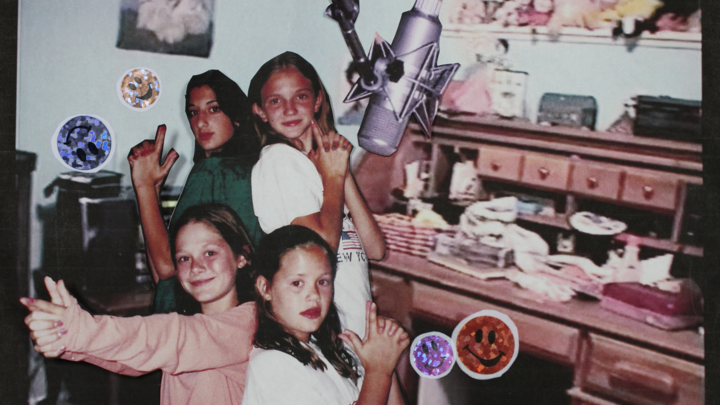
Credit: Dessie Jackson
While Mayeri spends her days on set, she admits that being behind the microphone is a different type of performing that’s markedly more intimidating. She’s shared the screen with Alison Brie, Steph Curry, and Zooey Deschanel, but they don’t hold a candle to a mic.
“It’s so much scarier than acting. It’s so vulnerable. I really think that maybe it’s the most vulnerable thing in the world because you’re accessing some deep emotional truth, putting it out there, and everyone can hear if it’s not working.”
“It’s funny, I grew up doing musicals and I did sing, and my mom was very much like, you’re a singer. I was always saying I’m not good, I’m not good. I just stopped doing it. She still asks why I don’t take lessons. Why don’t I get back into singing. I’m like, mom, I’m not a good singer.”
“So to do this was horrifying. I also think that because it was in this context with my best friends and just saying who literally who cares if it’s cool or it’s good, it’s just for the sake of being creative, that was so fun. But I still feel like if you asked me to get out on stage and sing, it would be the scariest thing ever.”
“Even when we were young, we never did live performances. We were making stuff in our bedroom for a camera, you know? Now we’re like, we don’t have something to show. We haven’t rehearsed anything. I think it’s time to start working on something because I think the opportunities are going to keep coming.”
Midway through Summer 2000, the documentary pivots from a sweet ode to a relic of childhood that has skyrocketed to modern consciousness to a film about conversations these friends hadn’t had in all the years of their friendship. Not long after the album was finished, the girls started to go their separate ways. They were going into junior high. Suddenly, their friend group was expanding and boys were becoming very interesting. There were decades of words unsaid between these friends and, as both friend and documentarian, Mayeri found herself split between these two roles.
“I worked on it a lot in therapy. I talked to my therapist about all the logistics, all the planning, and all this stuff, but then I’m supposed to be free and creative with my friends. It’s hard to jump back and forth. My therapist and I did a bunch of visualizations where I was imagining putting on different awarenesses. Just allowing that to be and not saying I have to be all this thing, or I have to be all this thing. It really helped.”
“I went into it with a lot of intention of I’m going to be present, I’m going to be here. I made the film with my producing partner, Barry Rothbart. He shot it, my friend Nelly did sound, and my husband, M. Miller Davis, shot another angle. They were like, we’ve got this, you go be present. It was challenging, but it was cool. You can do hard things. You can do scary things and it will be a growth experience.”
Unlike Mayeri, the rest of X-Cetra did not pursue a career in Hollywood. They’re scattered across the country working various, more corporate jobs. Jessica works in tech, Janet in finance, and Mary in content management. It’s one thing for Mayeri to be vulnerable and emotional in a documentary, but it’s another thing entirely for the other women.
“We talked about it a lot. As a group, we decided that we wanted to really be honest about girlhood and our lives while still protecting and not overexposing anybody in a way that’s bad or scary.”
“We had these amazing editors, Phil Rosanova and Audrey Leach, and it would be them, Barry, and myself in the editing room. You craft the story after you shoot it with a documentary. When you write a narrative, you have the script and then you shoot it. As we were putting it together, there was a lot of thought put into how much we wanted to share.”
“At the end of the day, there was a lot of intention about being honest and making sure everyone’s okay with it. I showed the film to the girls and Robin before we did picture lock to say if there’s anything that’s too much, we don’t have to include it. Everyone was like, I’m comfortable with this, I want to show our real story and I want to talk about real things.”
In a few short days, the story of X-Cetra will grow even larger, to internet-folk-story status. SXSW isn’t a festival exclusively dedicated to movies, so the fact that X-Cetra comes together at an event that’s also a celebration of music is like the sticky glow-in-the-dark stars of the early-aughts aligning once again.
“It’s so cool. We’re going to participate in the music section too. We’re going to be introducing some bands and showing up, having little merch tables, photo ops, and things.”
“Every step along the way with this has been shocking and crazy. At this point I’m like, well, anything could happen now and nothing’s going to surprise me anymore because who knows, maybe we’re going straight to the Oscars. I don’t know!”
“It’s such an honor, and I feel like SXSW really gets it because they were like, this is really in the spirit of creativity and what we stand for. I so appreciated them supporting this little movie.”
Follow me on BlueSky, Instagram, Letterboxd, TikTok, YouTube, & Facebook. Check out Movies with My Dad, a podcast recorded on the car ride home from the movies and I Think You’ll Hate This, a podcast hosted by two friends who rarely agree.
Support Your Local Film Critic!
~
Support Your Local Film Critic! ~
Beyond the Cinerama Dome is run by one perpetually tired film critic
and her anxious emotional support chihuahua named Frankie.
Your kind donation means Frankie doesn’t need to get a job…yet.