
“The Mastermind” is the Anti-Heist Heist Movie
Schemers believe they’re always one win away from changing their status in life. One heist, one deal of the cards, whatever their vice may be, the next big thing is going to solve all the problems that plague them. Writer/director Kelly Reichardt has made a heist movie in a way that only she can. The Mastermind is less about the crime and more about the series of terrible decisions a man makes. Despite the title, this is not the story of a criminal mastermind or a world-renowned thief, but a desperate man who believes himself to be the very thing he is not.
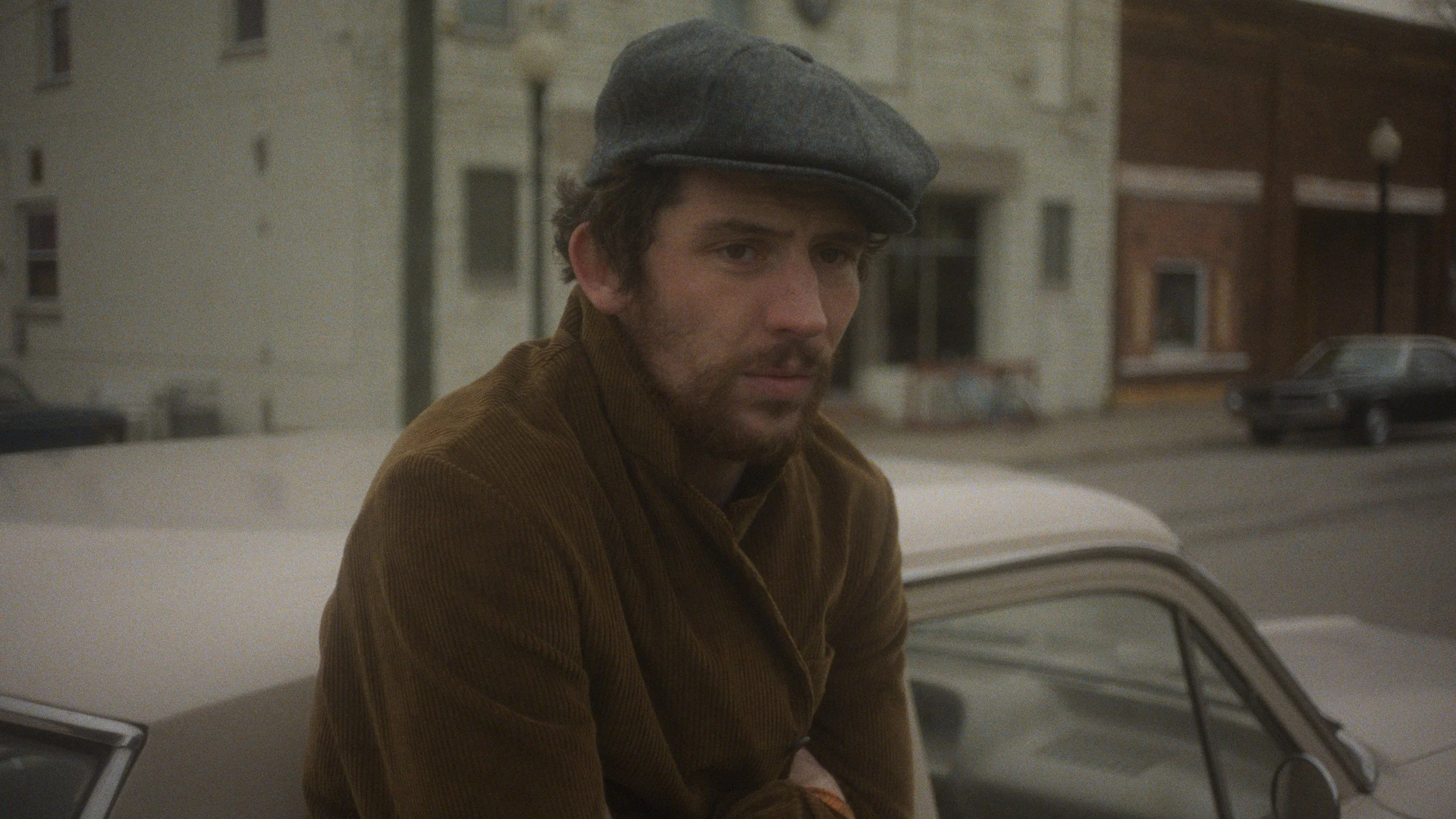
J.B. Mooney (Josh O’Conor) lives in Framingham, Massachusetts. It’s 1970 and America is filled with deep political, social, and economic unrest. Televisions and radios in the background talk of student protests against the Vietnam War, but J.B.’s focus is on his plans to rob the Framingham Art Museum. Four paintings by Arthur Dove have caught J.B.’s eye, and while Dove is not a household name at that point, J.B. believes the paintings will bring good money on the black market. While he does succeed in getting the paintings out of the museum and to his hiding spot, the world around J.B. quickly begins to unravel.
courtesy of MUBI
To come into The Mastermind expecting a heist movie like the ones that were popular in the era this film takes place is to be immediately disappointed. Reichardt’s film purposefully upends the genre trappings of the inciting incident. Ocean’s 11 this is not. The Mastermind’s thief is almost immediately under suspicion, and his only means of evasion is to mention that his dad (Bill Camp) is a judge. He’s an adult boy playing dress-up with no concept of the consequences of his actions, not a hard-boiled, well-prepared schemer.
J.B.’s place of privilege, both from his judge father and a mother (Hope Davis) who wires him endless money, is also clear in his choice of paintings to steal. He’s not going to start a bidding war with these four pieces, but his college professor was a big fan of Dove’s work. It almost seems that J.B. steals the art because he’s never had a sense of danger in his life. He’s more than old enough to be drafted for the Vietnam War, but his father’s connections likely sheltered him from that. J.B. is an unemployed carpenter, supported by his wife (Alana Haim) and his mother. The real consequences of this heist and the growing protests around him are just noise, frustrations that get in his way of doing what he wants.
“Honestly, I don’t think you’ve thought things through enough. No offense,” says a member of an organized crime group as he hounds J.B. for the painting locations. It’s a succinctly accurate description of J.B.’s actions throughout the film. Reichardt’s script doesn’t make him a smarmy, unlikeable character, but someone who’s oblivious to the world around him. However, in a time like the present and during the Vietnam War, to be oblivious is a political statement all its own. To be so removed from the world is a luxury that most people cannot afford. J.B.’s heist is an act of confidence by someone who has never considered that things might not turn out okay.
The Mastermind is mainly a character study. It takes the expectations the audience has for the archetypal character at the heart of a heist film, strips away the allure, and turns the mastermind into an ostentatious charade who cannot measure up. Reichardt’s gently moving, observational camera makes The Mastermind a heist in its own right. It’s a film that uses an as-described-by-J.B. “victimless crime” to demonstrate that the repercussions of an individual’s actions will always be absorbed by the larger community.
support your local film critic!
~
support your local film critic! ~
Beyond the Cinerama Dome is run by one perpetually tired film critic
and her anxious emotional support chihuahua named Frankie.
Your kind donation means Frankie doesn’t need to get a job…yet.

Follow me on BlueSky, Instagram, Letterboxd, YouTube, & Facebook. Check out Movies with My Dad, a new podcast recorded on the car ride home from the movies.