
“Blue Moon” Lacks the Magic of Old Broadway
2025 was a busy year for Richard Linklater, with the release of Nouvelle Vague and Blue Moon. While the two films have very little in common stylistically, Linklater was clearly inspired to take on both stories by the larger-than-life real people he focuses on. In Nouvelle Vague, it was the who’s-who of the French New Wave cinema. In Blue Moon, it’s the men who were the backbone of Broadway in the 1940s. While Blue Moon doesn’t crackle with life the way France did in the 1960s, it provides a glimpse into the life of a man whose world is slipping out from under him.
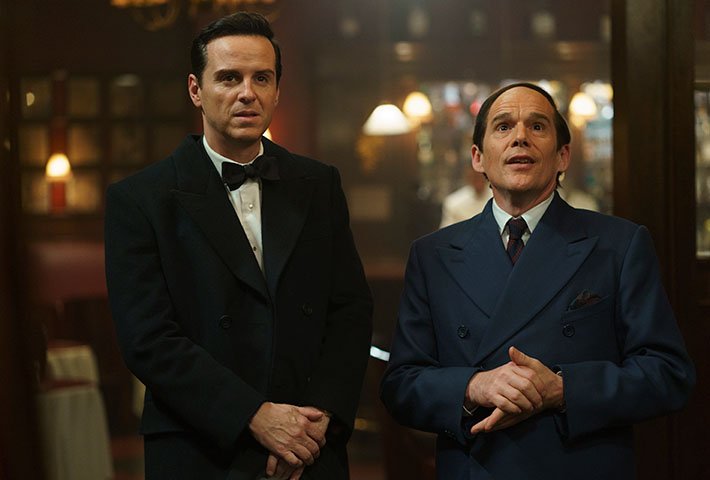
It’s March 31, 1943, and the premiere of Oklahoma! on Broadway. As the opening number ends in a flurry of tossed cowboy hats, a man groans and says he can’t stomach the whole show. That man is Lorenz Hart (Ethan Hawke), who wrote the lyrics to famous songs like “My Funny Valentine,” “Isn’t it Romantic?,” “Blue Moon,” and many more. Hart was one half a duo with composer Richard Rodgers (Andrew Scott), but Oklahoma! was the beginning of the end of that professional relationship. Oklahoma! launched the new, perhaps more famous, duo of Rodgers and Hammerstein (Simon Delaney). Blue Moon’s entire runtime is confined to the night of the Oklahoma! Premiere. It takes place in a bar as Hart reckons with the path his life has taken.
Courtesy of Sony Pictures Classic
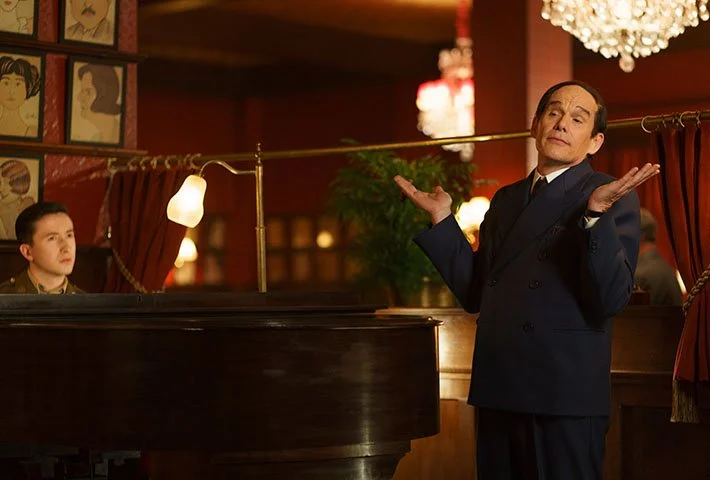
“He was alert and dynamic and fun to be around,” is the quote about Hart from Oscar Hammerstein II. Blue Moon gives us a window into that side of Hart. Hawke plays Hart as though he’s never met a stranger. He has the ability to treat people as if he’s known them their entire life, with a fabricated sense of familiarity that convinces Hart he has more friends than he really does. Everyone around him can see it, but you can never tell if Hart recognizes that in himself.
“He was the saddest man I ever knew” is a quote from singer Mabel Mercer that immediately follows the one from Hammerstein. That’s the impression of Hart the audience grasps instantly. From the moment he walks out of the Oklahoma! theater, it’s clear this man is deeply unhappy. He’s furious at what he rightly guesses will befall his friend after the premiere, but it’s not an emotion wholly rooted in jealousy. He’s also mad that he couldn’t write something like this, something that was a balm for New York as the United States careened further into World War II. He’s the sad man, sitting alone at the bar, on a first-name basis with the bartender (Bobby Cannavale), too in his own head to make himself function in the world.
Courtesy of Sony Pictures Classic
Given Hawke’s, Cannavale’s, and Scott’s previous stage credits, it’s somewhat shocking that Blue Moon wasn’t adapted into a stage play. The plot is tailor-made to create sold-out shows in New York. Like Hollywood, Broadway loves a chance to celebrate its own history. As it stands, Blue Moon doesn’t provide a compelling reason for this story to be told in film. It’s competently made because Linklater, and everyone he surrounds himself with, is a professional, but it’s a stark contrast to Nouvelle Vague, a film so obsessed with being part of this medium that Blue Moon feels flat. It’s a lot of monologuing from Hart. Each story he tells feels like a staged exposition dump rather than a seamless flow of a conversation and amounts to very little until Rodgers arrives with a searing bolt of electricity. When the film allows Scott and Hawke to share the screen as two old friends who both recognize their paths have diverged, but only one of them is willing to admit it, it provides an emotional reflection on how friendship changes when a career is involved.
“I’ve written a handful of words that will cheat death,” Hart admits at one point. He is, like many artists, deeply concerned with his legacy. When he dies, how will people remember him? It’s quite tragic to watch the film knowing what Hart will never know: his collaborations with Rodgers will pale in comparison to what Rodgers and Hammerstein will achieve together. However, spending an hour-and-a-half with Hart in this way doesn’t give the audience a deeper sense of how tragic his early death is because he’s been talking at the audience rather than speaking to them. There’s a way for a wordy, single-location film to use the freedoms of the film medium, look no further than Peter Hujar’s Day, but Blue Moon doesn’t capture the same sense of snapshot of a time and place in a person’s life.
support your local film critic!
~
support your local film critic! ~
Beyond the Cinerama Dome is run by one perpetually tired film critic
and her anxious emotional support chihuahua named Frankie.
Your kind donation means Frankie doesn’t need to get a job…yet.

Follow me on BlueSky, Instagram, Letterboxd, YouTube, & Facebook. Check out Movies with My Dad, a new podcast recorded on the car ride home from the movies.